Not for Ourselves, but for All: A Reflection for the Year of Saint Francis
Editorial

Some weeks bring together things that seem to have no connection, and only afterwards do we see a pattern. This has been one of those weeks for me: a night at the Catholic Schools Music Festival and a song that has stayed in my head; the anniversary we are marking this year, and the names our young people choose at Confirmation, and a Latin inscription on a building in Port Adelaide have all been speaking to one another. Together they say something about how we are called to live as Catholics in this Archdiocese in 2026.
A festival of many voices
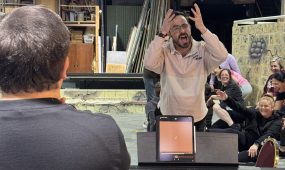
Anyone who has been to the Catholic Schools Music Festival knows the feeling in the room. Hundreds of students from across our Catholic Schools, from the city and the country, fill the stage. Some are confident soloists. Many more are one voice among hundreds in a massed choir, or one instrument in an orchestra, doing their small part so that the whole can sing.
What moves me every year is not only the talent, though there is plenty of it. It is the self-forgetfulness. A good choir asks every singer to listen more than they sing, to blend rather than stand out, and to serve the music rather than their own place in it. The young people on that stage are learning something the Church has always taught: we are most fully ourselves when we give ourselves to something greater. Behind them stand teachers, parents and staff who gave up evenings and weekends so that it could happen. None of them will get a round of applause of their own. All of them made the night possible.
Brother Sun, Sister Moon
One of the pieces that stayed with me from that night was a song many of us of a certain age will remember: “Brother Sun, Sister Moon”, the gentle title song of Franco Zeffirelli’s 1972 film about the young St Francis of Assisi. It was a gift to hear a new generation sing it.
The title comes, of course, from Francis himself. Near the end of his life, nearly blind and in great pain, he composed the Canticle of the Creatures. In it he praises God through Brother Sun and Sister Moon, through Brother Wind and Sister Water, Brother Fire and Mother Earth, and finally through Sister Death. What strikes me is that Francis wrote this song of joy not from a place of comfort but from a place of suffering. He had let go of everything, and in letting go he found himself a brother to all of creation. He no longer stood above the world as its owner. He stood within it as a grateful member of the family.
That is a quiet challenge to us in 2026. We live in a culture that measures worth by possession and visibility. Francis measured it by gratitude and belonging.
The Year of Saint Francis
It is fitting then, that the song returned to us this year. Pope Leo XIV has proclaimed a special Jubilee Year of Saint Francis, running from January 2026 to January 2027, to mark eight hundred years since Francis died in 1226. As we celebrated his feast on 4th October, the whole Church was invited to look again at the little poor man of Assisi.
Why does Francis still speak so powerfully after eight centuries? I think it is because he took the Gospel literally and joyfully. When he heard Christ say, “Go and rebuild my Church,” he first picked up stones and mortar. Only later did he understand that the rebuilding was to be done with lives: with poverty freely chosen, with care for lepers and outcasts, with peace carried into places of conflict, and with a deep reverence for all that God has made. He did not reform the Church by standing outside it and criticising. He reformed it by living the Gospel so fully within it that others were drawn to do the same.
The Jubilee invites us to do likewise. Not to admire Francis from a distance, but to ask what in our own lives needs to be given away, what needs to be rebuilt, and whom we have left outside the circle of our brotherhood and sisterhood.
Francis as a Confirmation name
I am always struck, when I celebrate Confirmation across the Archdiocese, by how many young people choose Francis or Frances as their Confirmation name. Year after year it is among the most common.
Sometimes it is a love of animals that first draws them. Sometimes it is his care for the earth, which speaks strongly to a generation anxious about the future of our common home. Sometimes it is a family connection, or the example of the late Pope Francis. Whatever the starting point, I believe the Holy Spirit is at work in that choice. When a young person takes the name of a saint, they are saying: this is the kind of disciple I want to become. This is the life I want to grow into.
That is a serious and beautiful commitment, and it asks something of the rest of us. If our young people are choosing Francis, they need to see Francis lived out in the adults around them: in our Parishes that welcome the poor, in families that practise simplicity and generosity, and in a Church that cares for creation and seeks peace.
A Confirmation name is not only a gift to the candidate. It is a question put to the whole community.
Non Sibi, sed Omnibus
The final thread came from an unexpected place. On a recent afternoon I found myself wandering around Port Adelaide, among the old stone buildings, the wharves and the reminders of the Port’s long maritime history. On the building of the Australian Institute of Marine Engineers I noticed an inscription: Non Sibi, sed Omnibus. Not for oneself, but for all.
It is a fine motto for a profession that works largely out of sight. Marine engineers spend their working lives below deck, among the engines and machinery that keep a ship moving. Passengers rarely see them. Yet without them no vessel leaves port, no cargo arrives, and no crew comes safely home. Their work is, quite literally, not for themselves but for all on board.
At the end of the week that bought together all of this, I thought of the choir at the Festival, of Francis singing his Canticle in his last illness, and of the young people who take his name. The inscription gathered them all up. Here, carved in stone on a building in an ordinary street, was the heart of the Gospel. Christ “came not to be served but to serve, and to give his life as a ransom for many”(Mark 10:45). The Christian life is not for ourselves, but for all.
Living it in 2026
What might this mean for us, as Catholics in the Archdiocese of Adelaide, in this Year of Saint Francis?
It means valuing the unseen work: the Parish volunteer who counts the collection, the catechist preparing children for the sacraments, the St Vincent de Paul member knocking on a door, the teacher who stays back after school, the carer at a bedside. Like the marine engineer below deck, they keep the ship moving.
It means learning, like a choir, to listen before we speak and to blend our voices, especially as we continue to receive the fruits of our Synod and walk together as a synodal Church.
It means seeing ourselves, as Francis did, as brothers and sisters to all people and to the whole of creation, and acting on that in the choices we make about how we live, consume and care for our common home.
And it means taking seriously the hope of our young people. When they sang Brother Sun, Sister Moon, when they choose the name Francis, they are showing us the way. Our task is to walk beside them and to make sure the Church they belong to is worthy of the saint they have chosen.
Not for ourselves, but for all: It would make a good motto for all of us this coming year, for God is good, good indeed!