We took up his bones: veneration of relics
Local

Recently in the Catholic News there was a lighthearted story of a man who inadvertently gave his rosary to the pope. Later, after having seen the pope pray with it, he managed to get it back. In an interview, the man remarked that the rosary meant so much more to him now because Pope Leo had prayed with it.
To cherish items that were used by someone we admire or even more, by those we loved but are now deceased, can be a powerful act of devotion. More than a memory, the items convey the values, personality, and relationships of the person, inviting us to experience them again and share them with the world. For the same reason, Catholics venerate the relics of the saints.
One of the earliest examples of the veneration of relics comes from the second century. After St Polycarp, Bishop of Smyrna, suffered martyrdom, the Church of Smyrna wrote that they “took up his bones” and buried them in a place where they could gather “in gladness and joy”.
They explained that the veneration of the body of the saint was not only to commemorate the one who died but also to train those who continue to live the faith. The saints witnessed to the faith through the physical body. Their relic does not have magical power, but it is a sign of God’s work in their earthly life. By venerating a relic, we express a desire that God’s work will continue in the world through us.
In the First Commandment (Exodus 20.3), God says “you shall have no other gods before me”. Devotional practices must be properly understood and experienced as an extension of the liturgical life of the Church. They need to advance the knowledge of the mystery of Christ and not become permeated by superstition (Constitution on the Sacred Liturgy, 13).
It is helpful to understand the classical distinction between adoration (latria) and veneration (dulia). Adoration (latria) is worship due to God as the Creator. We show it through the gesture of genuflection. Adoration is reserved for God in the Most Blessed Sacrament and for the Holy Cross from the solemn adoration during Good Friday until the beginning of the Easter Vigil.
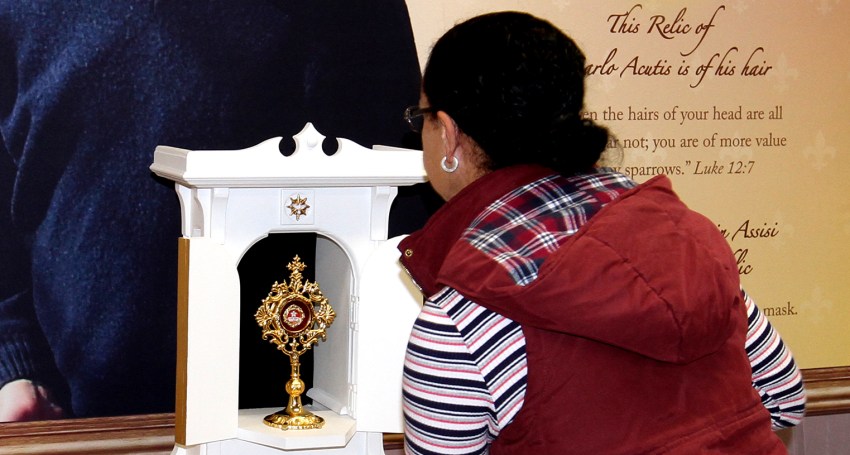
Veneration (dulia) is a sign of reverence or respect shown to a created person. We venerate by bowing the head or kissing or touching a relic or the case in which it is held (called a reliquary). If you are being blessed with a relic, you should kneel during the blessing.
The veneration of a bodily relic may seem gruesome but consider the crucifixion: with physical eyes we see a horrific death of a mortal body but the eyes of faith see the glory of the resurrection. When we profess the Nicene Creed, we profess our belief not only in Jesus’ resurrection but also that God “will definitely grant incorruptible life to our bodies by reuniting them with our souls, through the power of Jesus’ resurrection.”
(Catechism no. 997) The bodily relic of a saint is a reminder of the dignity due to all human bodies.
It may be difficult to look with bodily eyes on the pericardium of St Carlo Acutis that you are invited to venerate in our diocese 6 – 10 August 2026. Yet, in the same way as cherished items from our heroes and loved ones inspire us to take up their inner qualities, so do the bodily relics of the saints, gazed upon with the eyes of faith, invite us to recognise God’s work in the saint’s holy life and to continue that work in our own.
Dr Simone Brosig is Pastoral Leader, Community Life and Worship