Weighed in the balance
News
Dear sisters and brothers in Christ, in J.L. Carr’s short and quietly luminous novel A Month in the Country, (1980) a young war-scarred restorer named Tom Birkin spends a summer uncovering a mediaeval wall painting hidden beneath centuries of whitewash in a Yorkshire parish church. Layer by layer, he brings to light a great depiction of the Last Judgement: the falling damned, the risen blessed, and at the centre, Christ in glory. Birkin is not a believer, at least not in any straightforward sense, yet he cannot help being changed by what emerges beneath his brush. He reflects that the old painter, whoever he was, must have known something of both heaven and hell to have painted them so truly, and that the work has outlived its maker’s name, still speaking centuries later to a young man mending his own wounds after the war.
I have long found this a moving image for what it means to inherit a tradition of faith. Someone before us, whose name we may never know, saw fit to paint eternity onto the wall of an ordinary parish so that ordinary people, entering week by week for a wedding, a funeral, a Sunday Mass, would be reminded of the four last things: death, judgement, heaven and hell. Carr’s novel does not resolve this into easy comfort. It leaves us, like Birkin, standing before the painting, unsettled and instructed.
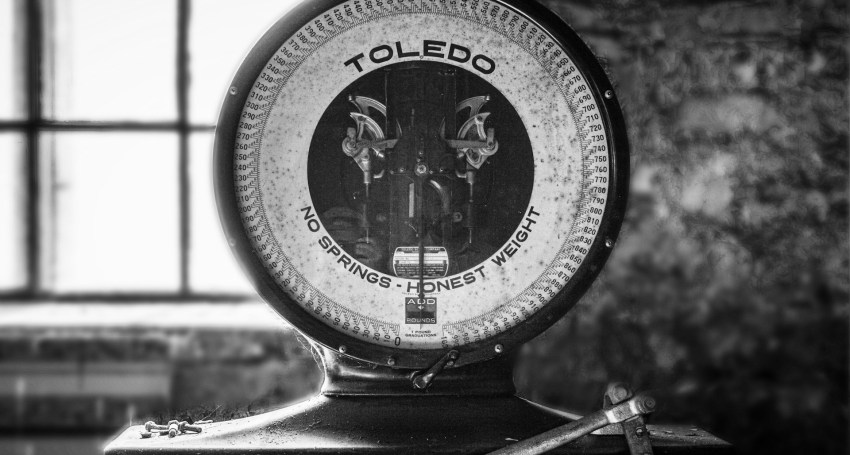
Many of our own mediaeval and Romanesque churches carried a similar image over their main doors: the tympanum of the Last Judgement, with St Michael the Archangel standing at the centre, holding a set of scales, weighing the souls of the dead. It is one of the oldest images in Christian art. The most celebrated example is carved above the west door of the cathedral of Saint-Lazare at Autun, in Burgundy, France where the twelfth-century sculptor Gislebertus set Christ in Majesty over a vivid weighing of souls, St Michael’s scales tipped this way and that as demons and angels contend for the same soul. From Autun to countless Cathedrals and parish churches like the one Carr imagines, this image’s logic seems at first glance to be starkly binary. Souls found wanting sink beneath the weight of their sins; souls found worthy rise into glory. It is a vivid, almost frightening picture, and it has often been read as if human life divides as simply as that: the good on one side of the scale, the bad on the other, and each of us assigned wholly to one side or the other.
I want to suggest, however, that such a reading, though understandable, misses something essential about the human person and about the God who judges us. None of us is wholly good or wholly bad. Each of us carries within us, in the words St Paul uses of himself, the good we would do and fail to do, and the evil we would avoid and yet find ourselves doing (Romans 7:19). This is simply the truth of the human condition after the Fall, and any honest examination of conscience will confirm it. We are none of us pure light, and none of us, thanks be to God, pure darkness either.
We live today in a culture that increasingly thinks in binaries: for or against, right or wrong, this side or that one, cancelled or celebrated. It is a world of “either-or”, where a single failure can define a person forever and a single achievement can seem to excuse anything. It is, in its way, a very old temptation dressed up in modern clothes, the same temptation that would have us stand before St Michael’s scales and imagine that our life reduces to a single verdict, weighed once and for all on the strength of our worst or our best moment.
The Catholic imagination has always resisted this flattening. Ours is a tradition of “both-and” rather than “either-or”. Christ is both fully God and fully human. Scripture is illuminated by both faith and reason. The Church is both a visible institution and a mystical communion. And the human soul, weighed by St Michael, is neither simply damned nor simply saved by its own ledger of deeds, but is met, at every point of that weighing, by a mercy that does not operate on the same scale at all. The scales tell only half the story. The other half is the outstretched hand of Christ above them, the wounds of his Passion still visible, drawing the soul toward himself regardless of what the balance shows.
This is why St Paul’s words to the Romans have always struck me as among the most consoling in all of Scripture: “For I am convinced that neither death, nor life, nor angels, nor rulers, nor things present, nor things to come, nor powers, nor height, nor depth, nor anything else in all creation, will be able to separate us from the love of God in Christ Jesus our Lord.” (Romans 8:38-39). Notice what Paul does not say. He does not say that nothing in creation can separate us from a favourable verdict, or from a scale, or from a final tally of merits. He says ‘nothing can separate us from love’. That is the ground beneath the whole Christian life: not a fear that we will be found too light, but a confidence that we are already, and irrevocably, held.
None of this excuses sin or dissolves the seriousness of the moral life. Birkin’s fresco does not let him, or us, off the hook so easily, and neither does the Gospel. Judgement is real, and our choices matter eternally; grace is not a licence for indifference. But we are permitted, indeed we are invited, to stand before the tympanum of our own lives not with the terror of a courtroom but with the trust of children before a Father whose mercy, Scripture tells us again and again, is greater than our sin. The task of the Christian life is not to tip the scales in our favour by our own strength, but to hand ourselves, good and bad together, honestly and without pretence, into the hands of the One who has already claimed us as his own. This is what we mean by grace: not a reward earned on the scale, but a gift given before we could ever have deserved it.
At the close of A Month in the Country, Birkin looks back on that summer as the happiest of his life, not because his wounds were healed, but because, for a season, he had lived close to something larger and truer than himself, painted by an unknown hand centuries before. I would ask each of us, this year, to look with fresh eyes at the old images of judgement that surround us, whether painted on a Yorkshire wall or carved above a Romanesque door, and to find in them not despair but grace. Let us resist a world that would sort people into simple categories of good and bad, worthy and unworthy. Let us instead hold together, as the Church has always taught us to hold together, the reality of our sin and the greater reality of God’s mercy, confident that whatever the scales may show, nothing in all creation can separate us from the love of God in Christ Jesus our Lord. In this way we know that God is Good. Good indeed!