Life after retirement
Local
In the dappled spring light surrounding Saint Joseph’s Church in Willunga, three retired priests gather to tell KATIE SPAIN about life’s next chapter and the Clergy Life and Ministry Team that helps them navigate it.

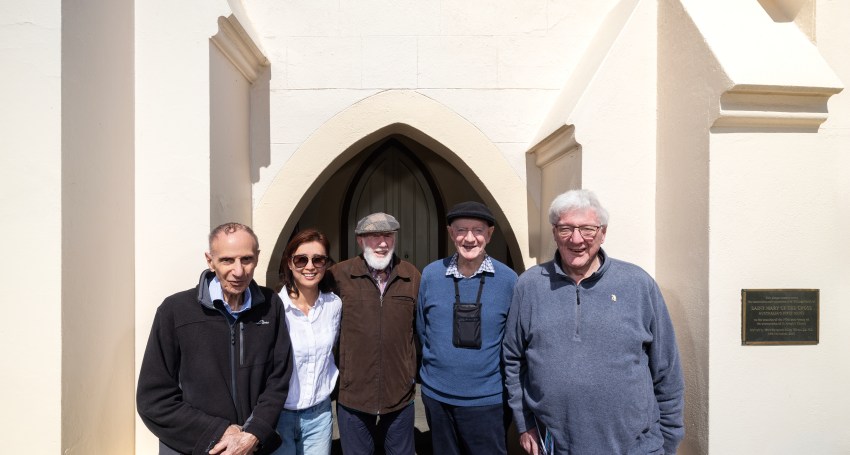
I hear them before I see them. When Fr Peter Milburn, Fr Bob Wilkinson, and Fr George Nader emerge from a car pulled up at Willunga’s old stone church, they are deep in conversation. Between them they have decades of priesthood, thousands of parishioners, and a lifetime of stories to share.
“I couldn’t get a word in edgeways on the drive here from Adelaide,” says clergy care coordinator Brie Yang. “They were so busy catching up.”
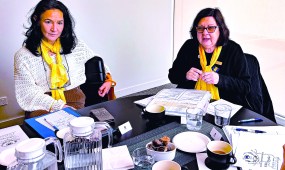
Brie is part of the Clergy Life and Ministry Team, led by manager of Clergy Care and Wellbeing Emma Grieve. The team works with about 100 clergy from the Diocese, including 36 retired clergy, and occasionally assists with religious order priests in retirement. They are appointed by the Archbishop and the team comprises priests, deacons and lay people.
Work is underway to look at many aspects of retirement planning and the transition to retirement including access to the pension, working with the property team to ensure that accommodation in retirement is suitable for ageing in place, and helping clergy reflect on their wishes for ministry as they age.
“I was employed in Archbishop Philip Wilson’s time, since 2013,” Brie says.
“Back then we had a model of one religious nurse and one social worker. The nurse focused on clinical care and the social worker took care of the social aspects and counselling.”
Over time, that combination has shifted. Now the team, including four nurses, bring different experience and expertise, from acute care, to community, and in-home support. “We all have our own strengths,” she says. “And we all contribute in the daily support for the priests.”
What hasn’t changed is the heart of the work: long term, relationship-based care.
“It’s a very unique job,” she says. “In hospital, it’s quick in, quick out, but working with the priests means that as long as we stay in the job, we know their history, their childhood background, and all about their priesthood. We see them as whole people; physical, mental, and spiritual.”
That perspective led to days and spring outings in the sunshine like this one.
After hearing each priest ask after, ‘how’s so-and-so? How’s Bob? How’s Peter? How’s George?’ the Clergy Life and Ministry Team decided to act.
“We thought, we can actually sit them together, have a coffee, have a chat,” she says. “Rather than them just being isolated, especially in nursing homes. We want to keep them connected.”
It works. Memories flow and much like the cheeky rainbow lorikeets chattering above in the trees above the church’s beautifully manicured gardens, these three have plenty to say.
“I’m Peter Milburn,” says the youngest of the trio. “Born the 29th of April, 1939… just before the war started.”
Now 87 and retired in Glengarry, Fr Peter Milburn’s priesthood has been, by his own description, a journey across the map of South Australia.
He ministered in regional areas including at Mount Gambier, Kingston SE, Naracoorte, Willunga, Nuriootpa and Kangaroo Island.
“I liked all the parishes I was in, I enjoyed every place,” he says. “And I think the reason was that there are always people who are
very good to you.”
His ministry extended beyond parish boundaries; he also served as a part time prison chaplain at the Adelaide Remand Centre from around 1989.
He remembers walking in for the first time, nervous. “The first time I stepped in the door I was a bit scared,” he admits. In the foyer he heard a voice: “Hello, sir.” It was a girl he knew from the South-East – a prisoner’s child.
“That was good in a way,” he says. “There were a lot of insights there… you see something of yourself in them. You see your own fragility and your own weaknesses. That’s how it hit me.” The priest’s role, he came to realise, was less about criminology and more about accompaniment.
“You’re there as a spiritual guide,” he says quietly.
Fr Bob Wilkinson nods. At 93, he too is neither short on words nor wisdom.
Born in 1933, he recently moved into Southern Cross Care Bucklands Residential Care. The change is still fresh. Asked how it’s going, he grins. “Great.”
Fr Bob’s vocation ran on twin tracks: priest and journalist. Ordained young, he was appointed editor of
The Southern Cross newspaper at just 25. While others might have settled into parish life alone, his ministry flowed into youth movements and lay leadership.
“I had a lot to do with the youth movement, the YCW [Young Christian Workers],” he says. “The newspaper job gave me the space to do that, and I had national work which was unusual for a priest.”
He later served as a university chaplain and even as secretary to a government minister, juggling sociological research with pastoral care. His passion, though, has always been the role of lay people in the Church.
“Most of the life of the Church is home life, work life and society,” he says. “A lot of mine has been trying to defend the essential role of people. The laity have the same dignity as the pope or the bishop, just different jobs.”
He affectionately recalls Archbishop Leonard Faulkner’s A-team. Faulkner was appointed Archbishop of Adelaide in 1985 and spearheaded a leadership group that included women as well as priests. “That was pretty famous.”
Meanwhile, Fr George Nader is an equally well-known Catholic priest and former talented sportsman who served in parishes including Colonel Light Gardens and Kangaroo Island. He was born in 1935 and has been retired 16 years.
Fr Nader’s transition to retirement came with its own challenges. Stepping back was not easy.
“For me, stepping back from the parish was a bit hard to cope with for a few weeks,” he says. “Maybe a couple of months.”
The remedy came in the form of saying Mass in parishes when a priest was away or unwell.
“You got into a bit of a pattern that way,” he explains. “You resumed contact with parishioners and that was very good. You could just say the Mass and leave all the responsibility to the parish council and the parish priest. So, it was most enjoyable.”
Even now, his ministry continues in quieter ways.
“I don’t go to many parishes these days,” he says, “except at two nursing homes: Calvary Flora McDonald Aged Care and Southern Cross Care’s The Pines Lodge Residential Care.”
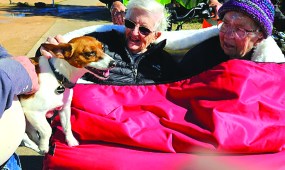
The nursing homes and retirement villages have become small parishes of their own.
As the trio chat, their stories are punctuated with laughter.
When Willunga priest-in-residence Fr Tom Gleeson appears at the door, the welcome is full of warmth and familiarity.
“I’ve been a priest for 70 years,” Tom says. “I’ve only been a parish priest for a year and a half. That says something about my intense administration experience.”
Laughter rattles through the gardens.
These long, layered relationships are exactly what the clergy care and well-being team is trying to honour and protect.
As the conversation bounces between memories of Mount Gambier’s old gaol, stories of parishioners now in aged care, and tales of beloved pets and football loyalties, the camaraderie is unmistakable.
“It’s remarkable,” Fr Bob says quietly. “We really don’t know one another terribly well. We all worked separately. You may have worked with someone, but… it’s more of a professional relationship than personal.”
Today feels different. As the three old colleagues climb slowly back into the car and prepare for the journey home they share a conviction that, retired or not, their vocation remains grounded in relationships.
“They impacted lots of lives,” Brie says. “That will never stop.”