Restoring heart to a house of God
News

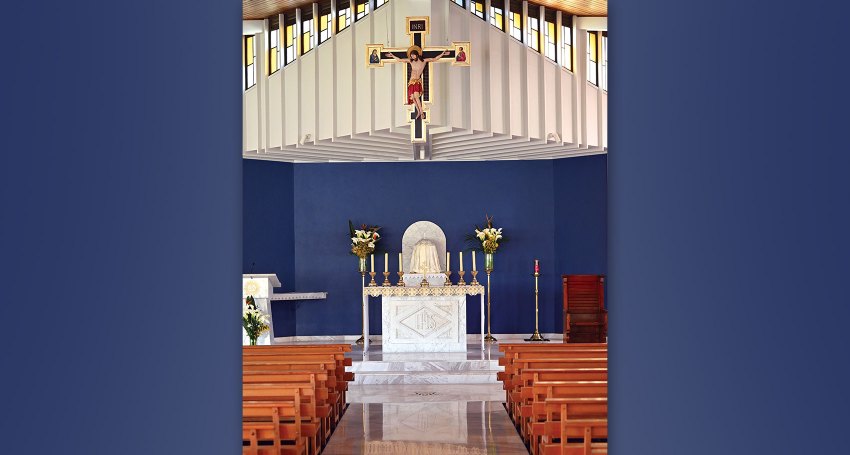
A 1970s church in Payneham with a particle‑board altar has been reborn in marble and grace, proof that when a community works together, it doesn’t just restore a building. It restores hope.
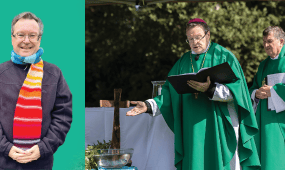
The first thing Father Romeo noticed was the altar. It was Holy Thursday and as he lifted cloth and candlesticks from the sanctuary at Our Lady Queen of Peace in Payneham, they discovered the altar wasn’t stone at all, it was particle board and it was in disrepair. Something had to be done.
Fortunately, parishioner Carlo Beltrame had the skills with which to do it. Aged in his early nineties, the stonemason has worked with marble his whole life.
“Carlo still attends Mass every morning and prays four rosaries a day,” says Fr Romeo. “In his younger years he helped dismantle and rearrange marble altars and sanctuary furniture across the diocese after the Second Vatican Council. He said, ‘Why don’t we make a new altar?’”
The conversation began simply enough but it was a big job.
Carlo mentioned he still had a historical marble piece from a dismantled altar stored in his warehouse, where it had sat untouched for 60 odd years. To recreate something like it today, he told the priest, would cost tens of thousands of dollars. Instead of letting it gather dust, he suggested they make it the centrepiece of a new altar.
“From that moment, the project grew,” Fr Romeo says.
“Carlo designed a new altar in Carrara marble, along with a matching ambo, credence table, stand for the tabernacle, a new baptismal font, holy water fonts carved by hand, and granite backings for the original stations of the cross.
“He said, ‘Why don’t we make this the feature? To make this today would be nearly impossible’.”
The parish could only afford the materials. The rest came from generosity. Carlo poured his time and skill into the work. Other parishioners followed suit, some donating labour, offering cost price, turning trades and talents into an act of worship.
“People started saying, ‘Well, why don’t we do this? And why don’t we do that?’ They donated their time, materials, money… otherwise it just wouldn’t be possible,” Fr Romeo says.
The marble was only the beginning. Inside, the once cream-brick walls were plastered and rendered. Leaking roofs were fixed, broken windows mended, long‑overdue maintenance finally done. The sanctuary was retiled and new carpet laid. The aisles were widened so funeral processions could move with dignity, and disability access was improved so people in wheelchairs and with walking frames could sit at the front without struggle. Overhead, a new crucifix, made in Italy, now hangs in the sanctuary. It is complemented by a stained-glass window designed and crafted by a parishioner. An organ, donated by a parishioner, completes the spectacle.
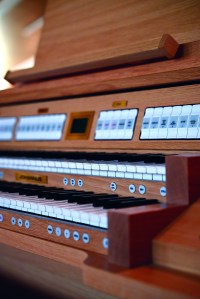
The new Johannus Ecclesia organ donated by a parishioner. Picture: Tim Coyle
The transformation is more than cosmetic, though. It has changed the way people pray.
“The beauty of the church has helped our prayer,” Fr Romeo says. “People just sit there and can really feel drawn into worship.”
Fr Romeo says Mass numbers are up at the church, particularly among 18 to 29‑year‑olds and young families. On a recent Sunday, around 300 people filled the pews in silence before the 11am Mass, evidence that the renewed space has become a place of encounter.
“Beauty leads to God,” Fr Romeo says. “We should have beautiful churches…that beauty then lifts the heart and lifts the spirit to God.”