Finally… the 2026 Synod agreement is signed
News
A little over 14 months since the Adelaide Diocesan Synod first came into the public spotlight, Archbishop Patrick O’Regan last night put pen to paper to ensure its findings and agreements, now become 'particular' law.

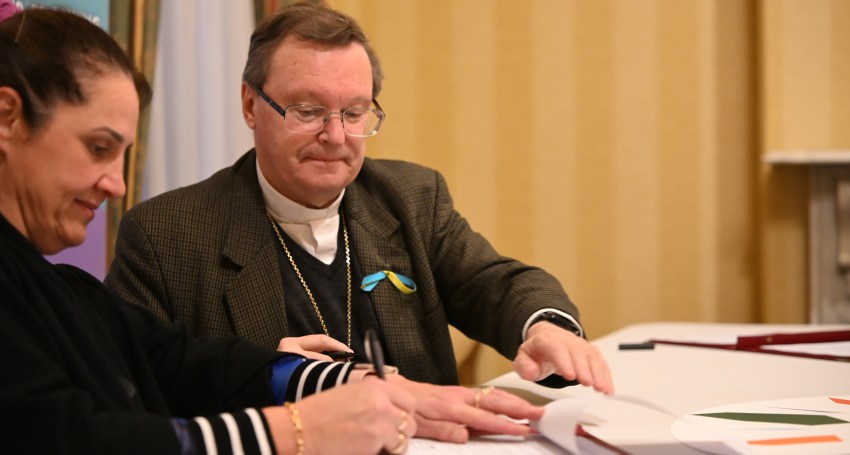
The official signing of the final document – the culmination of many months of research, listening and discovery – took place at Archbishop’s House on West Terrace where a clearly delighted Archbishop O’Regan signed one Decree and five supporting Declarations.
The Decree is the culmination of the 90 Synod members talking to thousands of parishioners within the Archdiocese over the past year about their hopes for the future of the Church locally and how to work together more effectively and in harmony.
The findings –set within five separate papers each dedicated to one topic of particular importance – were formulated first into a working document and then further discussed and agreed by the members at two Synod assemblies in May and June this year. This resulted in a final document which was then read and “lightly edited” by the Archbishop, although the responsibility has been anything but a rubber-stamping he said.
“My task has been to hold what we discerned together in prayer, to test it against the Gospel and the tradition entrusted to me, and to give it back to you not diminished but clarified. That is the work I complete today,” Archbishop O’Regan said.
The five key themes which were identified and presented in the working document “A Synodal Church on Mission’ are:
• Becoming Mission Disciples
• Communion in Grace- Sacrament to the World
• Mission of Catholic Education and Being Church Together
• Formation for Mission and Leadership
• Structures and Planning for Communion, Mission and Participation
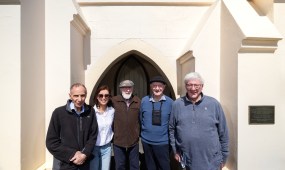
The Decree and Declaration were signed by the Archbishop, and notarised by his executive assistant Aida Joseph, in front of 14 members of the Synod and Diocesan Pastoral Council.
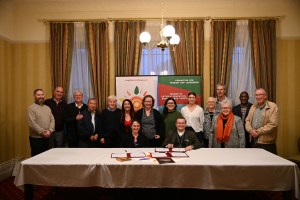
All smiles: Archbishop Patrick O’Regan and Synod members after the signing of the Decree.
Immediately before, the Archbishop told the witnesses present it was fitting that the decree was signed on 20 August, the Feast of Saint Bernard of Clairvaux, a 12th century abbot who spent much of his life urging popes, bishops and monks toward reform.
He told how Bernard wrote to Pope Eugene III warning him “against being swallowed by business and busyness, and offered him this counsel on the nature of episcopal responsibility: ‘What is required of you is the care, not the cure’.”
“A bishop, Bernard was saying, is not asked to fix the Church as though it were a machine in need of repair, but to tend it faithfully, patiently, as a shepherd tends a flock entrusted to him rather than owned by him,” the Archbishop said.
“I have carried that line with me through these Synod weeks, because it names something I have felt keenly in this role: that my task in receiving what we have discerned together is not to solve the Church, but to care for what the Spirit is already doing within her.”
Archbishop O’Regan then reflected on “the faces I saw in McLaren Vale and at Hahndorf (the Synod assemblies): lay men and women, religious, deacons and priests, young adults and older adults, all gathered under the banner ‘Together on the Way’.”
He paid tribute too, to the “quiet, often unseen labour of the organising group” led by Sarah Moffatt and Peter Bierer who head the pastoral services team with the Archdiocese as well as the many volunteers and countless parishioners across our Archdiocese who prayed for this Synod long before a single delegate took a seat”.
A Synod is not an event that happens on a stage he said, “it is the fruit of a community deciding, together, to listen”.
His final few words though offer the key to the success of the Synod. The Decree “is not the end of the Synod; it is the hinge on which the Synod turns outward, from the Cathedral into the parishes and pastoral arenas of this Archdiocese.”
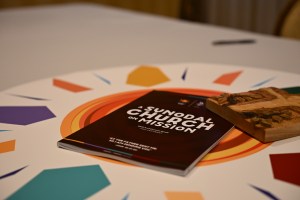
The final document as decreed by the Archbishop.
The hard work, effectively, starts now.
Every parish and pastoral arena should receive these five Declarations not as instructions issued from a distance, but as our own shared discernment returning home. They should be studied, prayed with and enacted locally according to the needs and gifts of each community the Archbishop said.
He asked that we resist the temptation to think the work is finished simply because the meetings have concluded and a Decree has been signed. And “that we carry the manner of these gatherings (patient listening, genuine attention to those different from ourselves, courage to name difficulty without despair) into the ordinary life of every parish and pastoral arena”.
This is the measure of a successful Synod he said, that our parishes “became more clearly missionary, more welcoming, more synodal in how they walk together” he said.
Synod_Opening Decree is available here.