NAIDOC – more than a name
Local
It was the middle of winter but the sun shone on Kaurna Country when Ngani Pari-Arra Cultural Centre hosted its NAIDOC Week event on 9 July. The space in Stepney is dedicated to truth-telling, connection and healing. All three were on show as Centacare’s Uncle in Residence, Les Wanganeen, addressed the crowd.

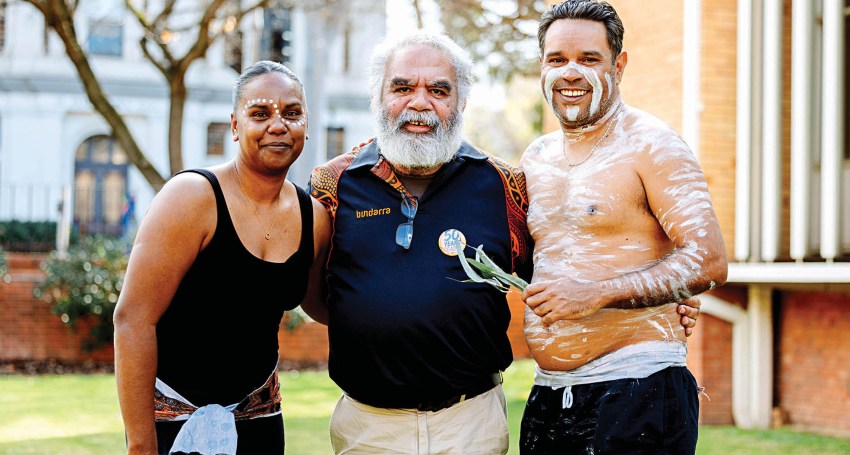
“For more than five decades, NAIDOC Week has given a voice to survival, resistance, culture and pride,” Uncle Les said.
“It has been a platform for truth telling, a celebration of identity, and a statement of continuity. It has reminded the nation that Aboriginal and Torres Strait Islander peoples have never been silent – we have been speaking, organising, creating and leading all along.”
This year’s NAIDOC theme was ‘50 Years of Deadly’.
“The theme is more than a slogan,” Uncle Les said. “It is a story and the story is about truth-telling. The story is a reminder that NAIDOC did not simply appear on a calendar. It was voiced by people who stood firm when the country would not listen to the true custodial people of this country.”
Uncle Les said 50 Years of Deadly honours every Elder, organiser, artist, advocate, community leader and family who helped bring this movement to the forefront.
“We are honouring the people who made space when there was none, who told the truth when it was uncomfortable, and who kept culture, family and community at the centre.”

Uncle Les Wanganeen’s grandson Gordon didn’t miss the chance to have his face painted. Picture: Bek Gratton
He said the story of NAIDOC began in advocacy, protest and courage.
“In the 1920s and 1930s, Aboriginal rights groups challenged the status and treatment of Aboriginal people and boycotted Australia Day,” he said.
“Leaders and organisations such as the Australian Aborigines League helped build a national voice for change.”
On 26 January 1938, as the nation marked 150 years since the arrival of the First Fleet, Aboriginal leaders and community members gathered in Sydney for the Day of Mourning. “They marched, they met, and they declared a truth that still echoes today: this country needed to reckon with the treatment of is First Peoples,” he said.
“We remember names like William Cooper, Jack Patten, William Ferguson, Pearl Gibbs, Doug Nicholls and many others – not as distant figures in history but as people who wrote, spoke, travelled, petitioned and stood up for justice. They helped move truth from the margins to the national conversation.”
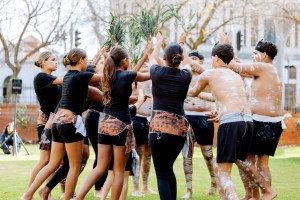
Dusty Feet Mob wowed the crowd with dance.
NAIDOC stands for National Aborigines and Islanders Day Observance Committee.
NAIDOC Week has its roots in the 1938 Day of Mourning and became a week-long event in 1975.
“What began as a day of mourning became Aborigines Day,” Uncle Les said. “It shifted to July so it could also become a time to celebrate Aboriginal culture, survival and achievement. In time, it grew into a full week. Later, Torres Strait Islander peoples were formally recognised in the name NAIDOC – the National Aborigines and Islanders Day Observance Committee.”
It is a moment in history that matters.
“It tells us that NAIDOC has always been more than an event,” Uncle Les said.
“It is protest and celebration, It is grief and pride. It is memory and momentum. It asks us to listen to the truth of what has been carried, and to recognise the strength it has taken for our communities to keep going. And today, that same fire continues. Aboriginal and Torres Strait Islander peoples are leading change across health, education, media, business, arts, community services and cultural life. We are telling our own stories, in our own ways, on our own terms.”
Ngani Pari-Arra Cultural Centre is home to regular Elders groups, cultural programs, and workforce support initiatives.
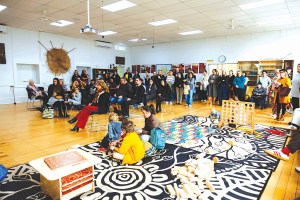
The NAIDOC Week event at Ngani Pari-Arra Cultural Centre.
Uncle Les acknowledged the Elders in the crowd. So too, did Wren Loades, Ngani Pari-Arra Cultural Centre’s Aboriginal services coordinator.
“I think of the Elders who gather here,” Wren said. “Who we are so honoured and privileged to be able to learn from and share stories with. Those stories, sometimes shared with a tear, a smile and often a good laugh. We are so privileged to be able to sit with these incredible Aunties and Uncles who have indeed defined the very meaning of 50 Years of Deadly. Fifty years of activism, raising families, navigating systems and standing strong. They truly have been the trailblazers of our community.”
Wren also reflected on what the terms Aunty and Uncle mean to Aboriginal people.
“A title of deep respect and also one of reciprocity and responsibility,” she said. “We are responsible to and for each other, and that is how Aboriginal pride and heart con-tinues to endure, even through great adversities and challenges.
“And this is why we do what we do, so that in time, when it is our turn to be Aunties and Uncles, our young ones can too step on our shoulders as those who have come before us continue to inspire us to keep rising.”
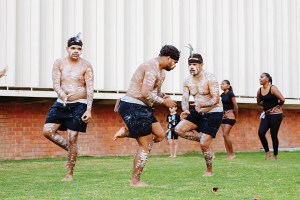
Dusty Feet Mob in action.
The afternoon also included time for reflection in the centre’s Healing Garden which launched in July 2025, and guests were encouraged to pause a moment by the new mural painted by local Aboriginal artist Thomas Readett which was unveiled during the 2026 NAIDOC Week celebrations.
Dusty Feet Mob, an Aboriginal dance group from Port Augusta, also ignited hearts and senses. Nearby, at The Gallery at St Peters Town Hall, art exhibition Kumangka Purka celebrated the Elders of the Ngani Pari-Arra Cultural Centre.
The display of paintings, sculptures, and wearable art was a delight. Throughout it all, the deep respect and gratitude for Elders was profound.
“As we mark 50 Years of Deadly, let us remember the people who brought this movement forward,” Uncle Les said.
“Let us remember the Elders who stood firm, the activists who organised, the artists who carried resistance through creativity, the families who kept language and culture alive, and the communities who kept showing up year after year.”
He also encouraged attendees to look to the future.
“To the next five decades to come, and to young people growing up proud. To the return of language, to connection with Country, to justice, to truth-telling, and to a future shaped by Aboriginal and Torres Strait Islander voices.”
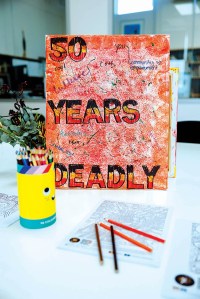
50 Years Deadly was the theme of this year’s NAIDOC Week.
What does ‘deadly’ mean?
A video created by Common Grace, a movement of people pursuing Jesus and justice, provides a wonderful breakdown of what the term ‘deadly’ means to Aboriginal and Torres Strait Islander people.
“It’s a really positive term,” said Safina Stewart from Common Grace. “It actually means, ‘you are awesome’. You are powerful, you are strong. So, when we say ‘50 Years of Deadly’ it’s like 50 years of awesome.”
Safina also explained the meaning of ‘mob’.
“Mob is a colloquial term. It’s a term we use for belonging and identity. Not where do you come from, but who is your mob? That’s going to get a much fuller answer because it goes straight to my heart, and I want to tell you all about everyone and everything that
I love.”
She said NAIDOC Week matters for a number of reasons.
“Back in 1938, remarkable Aboriginal leaders like William Cooper were leading the church and the broader community to have greater understanding of the predicament and plight of our Aboriginal and Torres Strait Islander people. NAIDOC Week is like the family reunion and the recovery week that we need in amongst the other 51 weeks of the year, where we are scrutinised.”
She also encouraged people to look to the future.
“I’ve been thinking about Philippians 4:8; Think about things that are excellent and worthy of praise,” she said.
“It really helps me to consider what is terrific about our Aboriginal and Torres Strait Islander community. What if the Church of Australia understood the full gift of that?
“What would God teach us? It would be remarkable. And that’s why I love the Christian faith, because faith is action with love, held together by the powerful, mysterious love of a wonderful Creator, an incredible Saviour, and a pretty awesome Holy Spirit.”