Midnight Mass is where Christmas begins
Opinion
At a few minutes to midnight on Christmas Eve, the world feels briefly suspended. The shops have closed, the traffic has thinned, and even the tetchy restlessness of city life in late December seems to fall away.
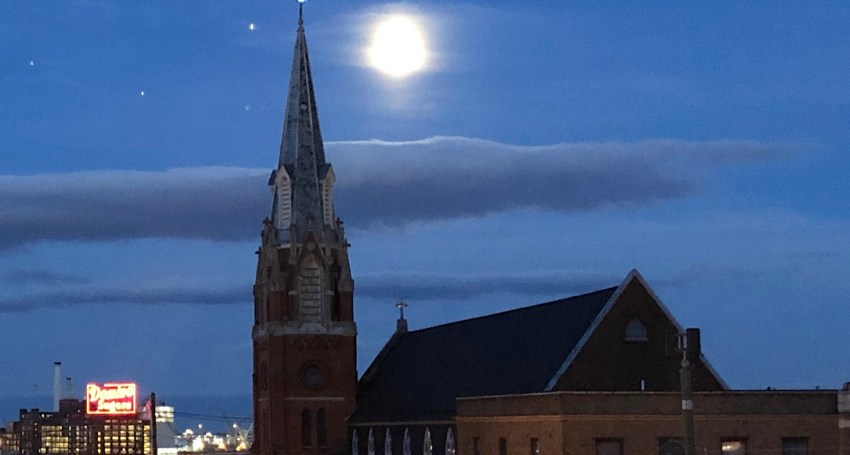
As you walk the dark streets toward the church, you feel a welcome sense of relief. There will be no more transactions, no more things demanding your attention. All that remains is to wander into a dimly lit church where it feels acceptable to drift into your own deeper, subliminal self.
Inside the building the air is warm and tranquil, sombre yet welcoming, with a low murmur of voices and the faint scent of wax. People who do not attend church at any other time of year sit beside those who come every week, all waiting in a hush that feels reverential, unsupervised and unmonitored. When the choir begins the first carol, the notes rise gently into the rafters, and for a moment you sense you have stepped out of ordinary time into something deeper, darker, and devoid of triviality.
For many who slip into a pew at this hour, the pull is not propositional but experiential. The Catholic Midnight Mass offers a kind of embodied experience that has become rare in modern life: unhurried, communal, and free of rational calculation. The service unfolds at its own rhythm, shaped by words, music, and gestures repeated for centuries. Traditionally, this is the Mass celebrated at midnight on Christmas Eve, first kept in Rome in the early centuries of Christianity and still held today in Catholic churches around the world. Even if you do not share the faith on which Midnight Mass rests, its antiquity creates a depth that cuts through the frantic surface of contemporary Christmas.
Part of the power of Midnight Mass comes from its timing. Doing anything meaningful in the middle of the night creates a small rupture in consciousness, a loosening of the routines that normally govern us. Artists, writers, musicians and thinkers have long treated the night as the hour when imagination is most alive, when the mind becomes receptive to what the day keeps at bay.
The philosopher Gaston Bachelard wrote that night opens within us an infinite universe. Mircea Eliade suggested that in sacred settings “time is not continuous, it is reversible, recoverable, an eternal present.” Midnight Mass draws even the non-believer into this suspended state. At this hour, when most of the city sleeps, the readings sound more solemn, the music more haunting, and the candlelight more vivid. The boundary between the ordinary and the mysterious thins.
Anyone who has attended Midnight Mass knows the particular stillness of waking on Christmas Day: a gentleness and a feeling that the modern world has loosened its grip. Early in the day, before the social obligations and expected cheerfulness, there is a quiet that feels closer to peace than anything else the season offers. Midnight Mass eases you into that state. You move from darkness into dawn carrying a mood shaped not by shopping centres or television specials, but by silence, slight fatigue, music and reflection.
You do not need to accept all the beliefs behind Christmas to recognise the human value of ritual. In a culture that has largely stripped public life of ceremony, participating in something ancient can feel grounding. It places you inside a story larger than yourself, one that reaches back through generations and reminds us we are not solitary individuals moving through an indifferent world.
Perhaps most refreshing is what Midnight Mass does not ask of you. It does not demand synthetic jollity or the bright surfaces of commercial Christmas. At midnight, in a darkened church, the season feels stripped back to something honest, something spacious enough to breathe.
As I walk home I notice a bright star hanging low in the sky. I assume I am overtired, then I pause and look again. For a moment I imagine standing in a field two thousand years ago, watching the night open above me, unsure what the star meant yet unable to ignore it. The warm summer air brushes my face and I realise that the climate here may be not so different from the night of the nativity. I picture returning to the fields the next morning, tending animals in silence, the memory of the night still hovering at the edge of awareness.
Jesus was known to pray alone at night, yet during the day he moved outward into the world, speaking, healing and confronting what needed to be confronted. That rhythm between solitude and engagement is becoming hard to recognise in our modern screen-based culture, where we are always on yet never truly engaged.
Midnight Mass helps us relocate that older contrapuntal rhythm. It invites you into silence, then sends you back into the world with a sense of inner peace. It honours the stillness of the first Christmas night while preparing you for the daylight that follows, when families gather and ordinary life continues.
In a season full of noise and notions of happiness that may not exist, Midnight Mass reminds us that Christmas begins not with celebration but with night, silence, and a single star.