Called: More moments over time, than Damascus
Vocations
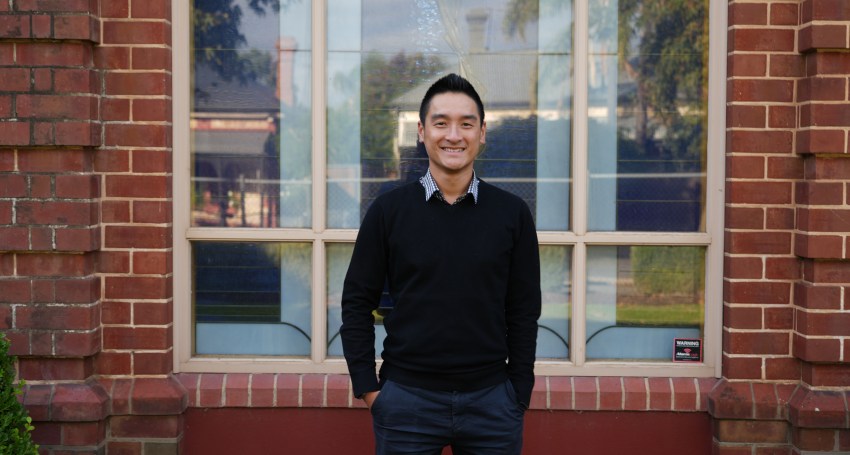
“Sometimes discerning when to let go, and giving yourself grace, is part of vocation too,” COYYA’s Julian Nguyen, a talented musician, tells TIM COYLE.
The Gospel of John tells us that ‘in the beginning was the word’. Saint Paul was famously called to his mission in an instant, ‘struck’ down on the road to Damascus. Moses beheld a burning bush, setting him on the path that God had ordained.
Our models for the moment God calls us, as understood through the bible, are instantaneous. They come in words, uttered in an instance, bolts from the sky, or the flickering of a flame. One moment we’re just a person gazing through a glass darkly, then in an instant later we’re changed utterly, given clarity, direction and purpose.
But speaking to Julian Nguyen, Coordinator of the Catholic Office for Youth and Young Adults (COYYA), Adelaide, one is given a sense of a calling that works at a slower rhythm; something insistent, steadfast and steady, more of a leitmotif playing over and over, giving shape, direction and identity to one’s life in service of the church. “It wasn’t a Damascus moment,” he says, “It was lots of small moments over time.”
“Growing up in the northern suburbs meant being very connected to the Vietnamese Catholic community,” says Julian when we meet at the Catholic Education South Australia offices in Thebarton, out of which COYYA is run.
“In the ’90s and early 2000s, a lot of Vietnamese families were based in those areas… That community played a pivotal role in our upbringing. School mattered, but community life featured very heavily.”
His parents were in his own words “boat people”, emigrating to Australia in the 1980s and ‘90s. While his family’s arrival in Australia may be seen as relatively recent, in many ways his experience is paradigmatic of the Australian Catholic experience: the Church has long provided support and connection to broader Australian society for diaspora communities, whether Irish settlers in colonial times and early federation, Italian immigrants in the mid-20th century, through to families from Vietnam such as Julian’s.
Combined with the steady contact provided with the Church and its teachings provided by St Gabriel’s Primary School in Enfield and a Jesuit education at St Ignatius’ High School, it provided a strong backbone for Nguyen’s growth and standing in the community.
“Having a strong faith-based and culturally grounded community meant that while I went to Catholic school during the week, on weekends I was immersed in a large Vietnamese Catholic community. That was always front of mind for me,” he says.
“Looking back through a vocational lens, service stands out. Being part of a big community and attending a Catholic school really shaped that… that sense of serving others was very formative.”
Another ever-present for Nguyen in those early years was music, also firmly embedded in the Church and local community. “My sister and I picked up music easily.,” he says. “Mum sang in the church choir, and still does. I spent 15 or 20 years singing in church choirs, so music was always around.”
While looking back it’s clear that being raised with such a keen sense of community and involvement gave a profound sense of direction to Julian, the transition into adulthood came with familiar doubts and uncertainties. “Throughout my early 20s, there was a real tussle, wondering where I belonged, how deeply I wanted to commit, and what faith really meant to me,” he says. “At times it felt easier to find belonging elsewhere: sport, friends, social groups.”
However, the sense of service he was brought up in remained a powerful cardinal point for him, with his education offering another path for him to express his deep rooted sense of community and service. “I realised I found deep joy in serving others and supporting community life,” he says. “That led me to study a Bachelor of Social Work. My godfather was a social worker, and hearing about his work made a strong impression on me.”
“I started working with disadvantaged and disengaged students, then moved into child protection, which is very confronting work, and later into work with young offenders,” he says. “Throughout it all, the thread was always working with young people. That calling was consistent.”
Exposure to the realities would test the faith of many young people who come into contact with social services. Julian never flinched from the challenging nature of the cases he handled and the struggles he was required to witness, saying that faith gave him a sense of hope.
“Not in a converting sense, but in believing people deserve second chances, listening to their stories, building trust, and focusing on rehabilitation. Catholic social teaching aligned very closely with that work.”
At COYYA his calling to make a difference in young peoples’ lives and his faith have collided, as he now oversees “youth ministry across parishes, communities, and schools in the Archdiocese of Adelaide” while advocating “for youth within policy and planning contexts”.
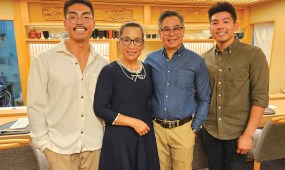
Another part of his life that provided a robust connection to the Church and community was his relationship to his now-wife. They met through youth group in their teens, and Nguyen explains that “having a partner who was also deeply connected to the community helped enormously.”
Julian’s sense of service, community and commitment to the Church has found a life of its own through his marriage and recent entry into the world of fatherhood. “Our son was born last November,’ he says. It has been “challenging, but incredibly joyful. It changes everything.”
The arrival also intersects meaningfully with how Julian’s call to enact his faith plays out in his professional life: “it also deepened how I understand the work I do with young people and families, especially around attachment and stability.”
Julian recalls that for a time he entertained ideas of life as a professional musician. Through an accomplished bassist, the path of that profession is narrow and often lacking in the support that has been such a feature of Julian’s life since his childhood in his Vietnamese Catholic community.
“I realised serving others gave me more purpose,” he says. “Music still plays a role, especially through ministry, but I didn’t pursue it professionally.”
There aren’t regrets in having not pushed any further with a career in music, as his answering the call of so many of the state’s young people and supporting them in realising their own potential has resonated deeply. Of his pursuit of the latter over a career in music Julian says “sometimes discerning when to let go, and giving yourself grace, is part of vocation too.”
They are the words of a man who has embraced the slow, steady and enduring.