Why very little happens without the help of St Barbara
News
The tiny, porcelain statue that was blessed by Archbishop Patrick O'Regan on Monday 25 May will sit in the entrance to the South Road tunnel at Clovelly Park. It has a long and fascinating history.

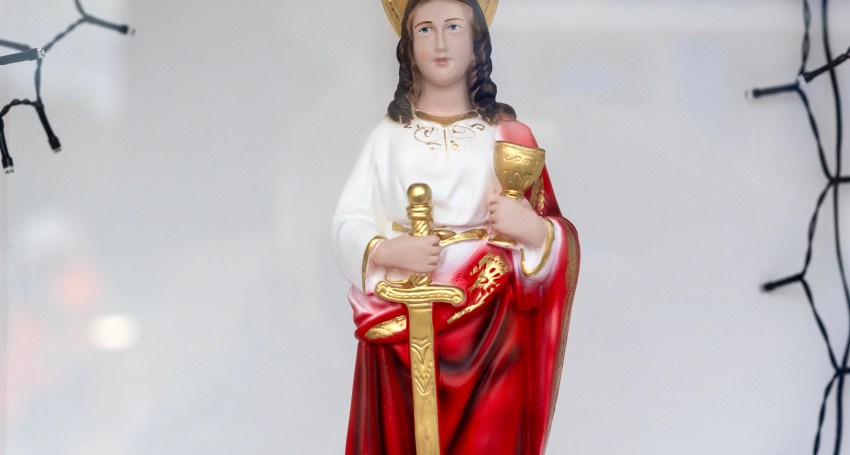
Saint Barbara was little known outside Europe until the 1500s when European priests moving into parts of Asia spread the word and her importance, and relevance, grew steadily.
Today, the patron saint of tunnellers, miners and anyone working in underground construction, is fundamental to all work carried out in her sphere. And, like many of her saintly contemporaries, she comes with a fascinating backstory.
Born around 300 AD, in what is probably northern Syria today, Barbara was the only, and beautiful, child of a wealthy pagan couple and doted upon by her father, Dioscorus. Such was his concern that she grew up untroubled by the world around her, that he locked her away in a gilded tower as she grew older and when he went away on a trip.
There, with time to read and think, she discovered and secretly converted to Christianity, making three windows in her bathhouse to showcase the Holy Trinity to those in the know.
Dioscorous was furious when he found out and after several attempts to bring her back to paganism failed, beheaded his daughter and was then himself killed by lightning on his way home from the execution.
Barbara’s association with the lightning that killed her father has caused her to be aligned with protection against lightning, fire and explosions and she is also the patroness of artillery and mining.
Her miracle, it is believed, came one day when she was stood by her pool and facing the east. “In the name of the Father, the Son and the Holy Spirit,” she said before drawing the sign of the cross in the hardened marble wall of the bathhouse with only her finger making the holy impression.
She is too, one of the ‘Fourteen Holy Helpers’, a collective of 14 Catholic saints venerated together for the believed efficacy of their intercession against specific diseases and perils. Originating in 14th century Germany during the Black Death, this devotion was used to seek protection from epidemics and sudden dangers.
It is as the patron saint of tunnellers though that she is best known, particularly through Asia where many construction projects will not begin until a small shine to St Barbara is placed (usually) at the tunnel portal. This is invariably followed by a prayer to her for the protection of everyone who works on the construction of the tunnel.
Tunnelling, and particularly outside Australia, remains highly dangerous work with high fatality rates and St Barbara’s presence incorporates faith, hope and tradition. There is also an annual St Barbara’s Day on 4 December to commemorate miners and tunnellers who have lost their lives that year.
Hugely popular, she is also the patron saint of mathematicians and, curiously, of the Italian Navy (the word Santabarbara translates to the box – or powder magazine – where explosives are safely kept).