MPs head to church as the Parliamentary year opens
Local
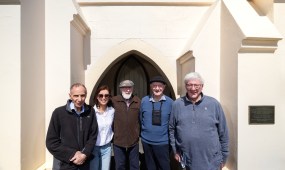
The bluestone Flinders Street Baptist Church on the corner of Divett Place has been in situ since 1863. It’s a beautiful, Gothic style, building but even when the jacaranda tree outside is not obscuring it in late spring, it fits into its surrounds and can easily be missed.

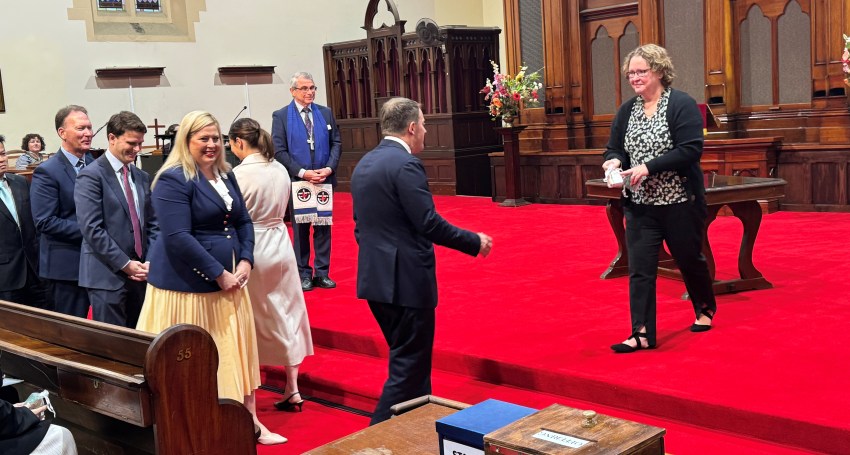
Although anyone passing just before 8am on Thursday 7 May might have noticed a strong cohort of the great and the good of South Australia’s politicians who had gathered for an annual service to mark the opening of the State Parliamentary year. And which, save for the Covid interruption, is the 56th consecutive occasion it has been hosted there.
Premier Peter Malinauskas, wearing his navy blue best suit, led the charge with Dennis Hood MLC and Katrine Hildeyard MP also among the better known 60 or so attendees. The Anglican Archbishop Brad Billings, Rev Dr Melinda Cousins and Vicar General, Fr Dean Marin from the Catholic Archdiocese of Adelaide were among the religious leaders present.
Reverend Peter Morel opened proceedings before Dennis Hood told the congregation that the privilege politicians have to work in Parliament is not to be taken lightly, while (joking or not) reflecting on the diminishing esteem in which politicians are currently held. The church service happens two days after Parliament officially opens, he noted.
“By the time Parliament has sat for two days, most politicians are looking for somewhere to repent,” Mr Hood said.
It was a good line but it was the reflection by Dr Cousins that was the morning’s standout delivery.
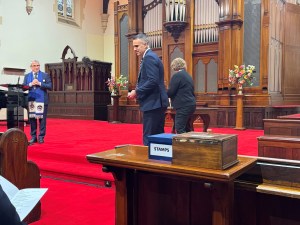
Premier Peter Malinauskas accepts his gift as the service ends.
“South Australia was a pioneer in religious freedom, (the) first in the British Empire to formally separate church and state,” she said.
It came from an understanding that when any one voice claims all authority, both faith and public life are diminished.
“And so space was made. Space for conscience and for persuasion rather than compulsion. And we’ve been negotiating how best to use that space ever since.”
The challenge to seek unity while holding diversity is real and often messy she told the congregation, and is intensified by social media.
“Dissent is not an unfortunate disruption to be managed, it is part of our inheritance. It’s a sign that people care deeply enough to contend for what they believe to be true and good.
“But it raises challenging questions. How do we hold our differences well? What kind of leadership ensures that difference does not harden into division? The temptation is usually to treat dissent as a problem to be solved, or worse, to be silenced.
“Yet that founding vision of our state suggests a different path. A kind of leadership that’s not about eliminating disagreement, but about sustaining a community where difference can be engaged without contempt and navigated without fear.”
Leadership is not the securing of advantage for our own side, but the patient, costly work of attending to the wellbeing of the whole, Dr Cousins said.
To illustrate this, she told the story of the Union Theological College, the training college of the Baptists and Congregationalists.
“In 1882 they sought an endowment from mining magnate Walter Watson Hughes. When his offer was far more generous than they’d anticipated, the church leaders met and made a staggering decision.
“Rather than keep the gift for the strengthening of their own institution, they urged it be donated to create a public university for the good of the whole community. That was the origin of the University of Adelaide.
“It was a moment of generosity rather than accumulation. When advantage was offered but service was chosen instead. It was a courageous decision that said the flourishing of the wider society matters more than our own advancement.
How do these words resonate today? She asked.
“We too live in a society marked by deep differences. No single voice can claim the whole. The question is not how one perspective prevails, but how shared life is meaningfully sustained for all.”