War represents a failure in human relationships and must be avoided.
Local
Fr Dean Marin, Vicar General of the Archdiocese of Adelaide, invoked the spirit of the Gettysburg Address in his Anzac Day homily, to reflect on the fragile ceasefire in the Middle East. The homily is published in full.

The Sermon on the Mount of Jesus clearly sets our attitude to war.
“Blessed are the peacemakers, they will be called children of God” and then “love your enemies and pray for those who persecute you,” it says.
And throughout the centuries Christians have struggled with these ideals in the face of those who use violence and war to perpetrate evil on others. We’re not naive, dreamers and absolute pacifists. We live in a complex world of tensions.
Catholic tradition from Augustine, to Thomas Aquinas to Robert Bellarmine and beyond has responded with what’s called the ‘Just War Theory’ which from our Christian perspective gives the conditions when war may be justified.
A short summary:
• War must be undertaken by lawful authority, e.g. by a sovereign head of state and must be for a just cause.
• There should be a significant balance between the good to be accomplished and the accompanying evil involved and war must be the last resort. There must also be a fair hope of success.
• There has to be a right intention, that a nation’s cause must not only be just, but known to be just. There should also be the right use of means, which means no intrinsic injury to innocent people.
Traditionally, we think about war as a defensive mechanism in the face of aggression. The questions remain with what’s called a pre-emptive war and whether nuclear war with the scale of loss of life and devastation calls all of this into question.
War, as a last resort, does mean that it is a failure in human relationships and is to be avoided. No wonder Pope Leo prays for peace and calls all involved to seek dialogue in ending this war. No wonder he responds to language that calls for the annihilation of a whole nation. “Blessed are the peacemakers”
When studying in Chicago, I took the train to Springfield, Illinois, the town where Abraham Lincoln practiced law for many years before entering politics. Also, I’ve been fortunate to visit Gettysburg the site of the strategic battle between the Union and Confederate armies. It was a killing field on both sides and here Lincoln delivered his now most famous ‘Gettysburg Address’ at the cemetery where initially soldiers from both sides were buried.
With his opening words ‘Four score and seven years ago’ phrasing with biblical overtones, you can feel Lincoln struggling to find meaning from a divine perspective in this war.
“The world will little note, nor long remember what we say here, but it can never forget what they did here,” Lincoln said.
He came to take inspiration from their sacrifice for the cause of right which he saw as saving the union of the American states and freeing it from slavery. Even in war Lincoln could see beyond partisanship and political divisions. His view was “with malice towards none, with charity for all”.
For those who lost their lives through war, our readings today give us hope. Christ passed through the sacrifice of his life and rose again to a glorious new life. He now becomes the hope and confidence for all who die in him, giving their lives for others.
In our first reading we heard, “In the eyes of the unwise, they did appear to die, their going like a disaster, their leaving us, like annihilation, but they are in peace”.
And from the Gospel, “Anyone who loves his life loses it; anyone who hates his life in this world will keep it for eternal life”.
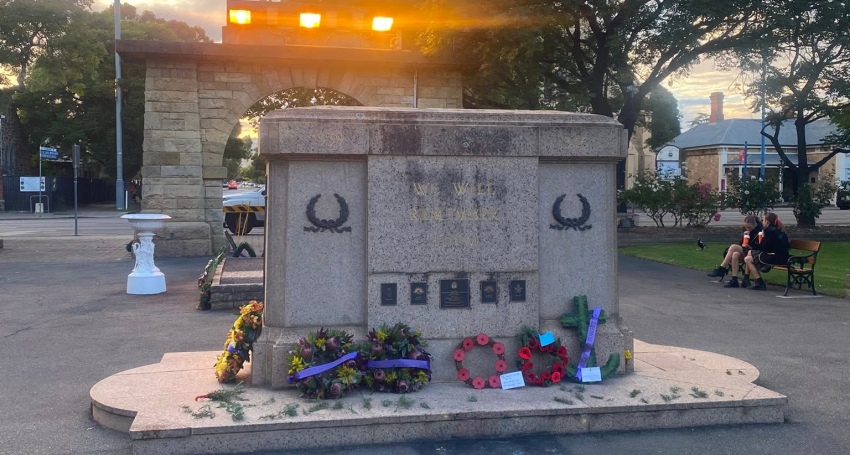
For us as Australians today, we come to remember, “Lest we forget” the sacrifice of those who gave their lives. We come as peacemakers, not as partisans, not glorifying war, not judging but remembering those who gave their lives in the service of their country.
And we remember all those men, women and children whose innocent lives too were lost through war. We come to continue to pray for peace and reconciliation. We know that ultimately if there will be peace in human relationships and world affairs, it begins with the peace of Christ that frees every human heart from fear, hurt, anger, revenge, self-interest and the desire to dominate.
And as Anzac Day is about memory and sacrifice, at the heart of this and every Eucharist, we remember the sacrifice of Christ on the Cross. It had power to heal, forgive, reconcile and unite.
“When I am lifted up on the cross, I will draw all to me.” This is our prayer today.
Today for us, it’s about memory and sacrifice. As we honour the memory of those who sacrificed their lives may we be inspired to do likewise for peace and unity in our families, community, our country, Australia and indeed the whole world.