Bringing buildings to life
News
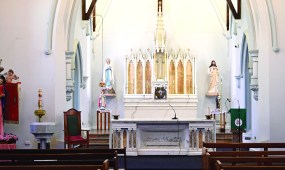
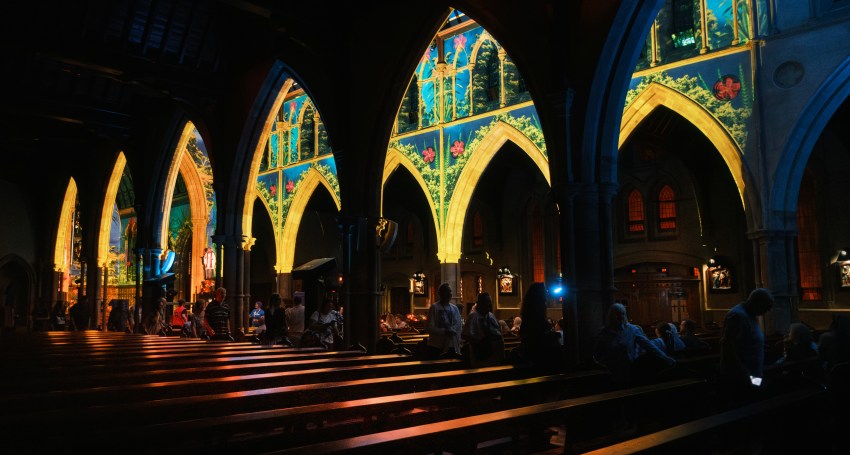
This February and March saw St Francis Xavier’s Cathedral turn into a canopy of light and darkness as its walls and ceiling glittered daily as part of an inaugural Adelaide Fringe. Don’t just treat churches as museums says ARCHBISHOP PATRICK O'REGAN. They are so much more than that.
There is a particular kind of blindness that afflicts the modern person — not the blindness of darkness, but the blindness of too much artificial light. We have grown so accustomed to information that we have lost the capacity for meaning.
We see everything and perceive very little. It is precisely here, in this crisis of perception, that the Christian imagination becomes not a luxury but a necessity.
St. Bonaventure, the 13th-century Franciscan theologian and mystic, offered the Church a vision of reality that is at once rigorously intellectual and breathtakingly poetic. For Bonaventure, God is not a distant architect who built the universe and left. God is a Speaker who never stops speaking. And He speaks through two great books: the Book of Scripture and the Book of Nature.
The first book: Scripture
The Book of Scripture is, of course, the revealed Word — the self-disclosure of God in human language, culminating in the Word made flesh. For Bonaventure, Scripture is not merely a historical record or a moral handbook. It is a living grammar through which God teaches humanity to read everything else. The pages of Scripture train the eyes of the soul. Without them, the second book remains closed, its words unrecognisable.
This is why imagination, formed by Scripture, is not fantasy or escapism. It is a disciplined, schooled capacity — the ability to see the world through the story of creation, fall, and redemption.
The Christian who is soaked in Scripture does not simply read the Bible and then go out into a neutral world. They go out into a charged world, a world already saturated with meaning because the Author is still present in it.
The second book: Nature
This is where Bonaventure’s vision becomes startling in its beauty. The visible world, he argues in his Itinerarium Mentis in Deum (The Journey of the Mind to God), is a mirror — a speculum — that reflects the invisible God. Every creature is, in a sense, a word spoken by the eternal Word.
The stone, the river, the sparrow, the human face: each is a trace (vestigium) of the Trinity impressed upon creation, a fingerprint left by the divine hand.
Following in the footsteps of his teacher St. Francis, Bonaventure understood that to walk through a forest was to walk through a kind of cathedral, that to study the stars was to study the grammar of divine generosity. Brother Sun and Sister Moon were not metaphors invented for poetry’s sake — they were, for the Franciscan imagination, genuinely fraternal because they shared the same Father.
This is the heart of Christian imagination: the refusal to accept that the world is merely material. Matter matters, precisely because it is not merely matter. It is meaningful. The created order is not a brute, silent fact — it is a language. And imagination is the faculty by which we learn to hear it.
Living buildings, not museums
Nowhere is the question of Christian imagination more urgent than in our relationship to sacred space — and specifically, to the church building.
There is a creeping temptation in our time to treat churches as museums: places of historical preservation, cultural heritage, aesthetic admiration. We speak of “maintaining” them, “preserving” them, ensuring they remain “as they were.” And while there is something right and good in caring for what has been handed down, the museum mentality ultimately misunderstands what a church is.
A museum is built around the past. It is a house for things that no longer live. A church, by contrast, is built around a Presence. The stones are not merely old — they are oriented. The altar points to a sacrifice still offered. The font still drowns and raises.
The light still falls through windows not to decorate, but to instruct. Every arch, every icon, every carved creature on a capital is a page in Bonaventure’s second book — creation brought inside and consecrated, nature shaped into praise.
The great medieval builders understood this instinctively. They populated their cathedrals with the whole cosmos: angels and gargoyles, wheat and grapes, sun and moon, the signs of the seasons, the labors of the months. They were not decorating.
They were doing theology. They were saying: all of this belongs to God, and God is present here. The building was not a container for worship — it was itself an act of worship, a stone sermon, a world recapitulated and offered back.
A living building breathes. It fills with the cries of infants at baptism and the silence of the grieving at funerals. It bears the wear of knees on stone. It smells of incense and beeswax and the slow accumulation of prayer. It changes with the liturgical seasons — stripped bare at Lent, blazing with fire at Easter Vigil. It is not static. It is a body that participates in the life of the Body.
Recovering the Imagination
What would it mean to recover this Bonaventurian vision today? It would mean, first, reading Scripture not as a document to be analysed but as a world to be inhabited — letting its imagery, its typology, its great narrative arc reshape the way we see ordinary things.
It would mean recovering a contemplative attentiveness to the natural world, the willingness to slow down long enough to ask: what is this creature saying about its Maker?
It would mean entering church buildings not as tourists checking off a heritage site, but as pilgrims crossing a threshold — recognising that the space itself is speaking, that the arrangement of stone and light and symbol is a form of catechesis for those with eyes to read it.
And perhaps most fundamentally, it would mean accepting that the Christian faith is not primarily a set of propositions to be believed, but a vision to be learned — a way of seeing the whole world as the theatre of God’s glory, the two books open before us, waiting to be read.
The world, as Bonaventure saw it, is not silent. It is singing. The Christian imagination is simply the ear trained to hear it.