Lent: A season of holy homecoming
Opinion
Each year, as the season of Lent begins, I find myself thinking of an old story told about the desert fathers, those hardy, sun-scorched pilgrims who fled the cities of the ancient world to find God in the silence of Egypt and Syria.

One novice monk, they say, went to Abba Moses and asked him a single, earnest question: ‘Father, what must I do to be saved?’ The old man looked at him for a long time before answering. Then he said simply: ‘Go, sit in your cell, and your cell will teach you everything.’
I have returned to that story many times over the years. There is something about its spare simplicity that captures what the Church is trying to give us in these 40 days. Lent is not primarily a program of religious self-improvement. It is not a spiritual boot camp or ‘spiritual get fit campaign’. It is an invitation, extended with extraordinary tenderness, to stop, to sit and to allow the silence to reveal what we have been too busy or too frightened to face. It is, at its heart, a season of holy homecoming.
As we walk together through this Lenten journey to Easter, I want to offer three reflections on what I believe lies at the very centre of this sacred time.
I We are invited to see ourselves clearly
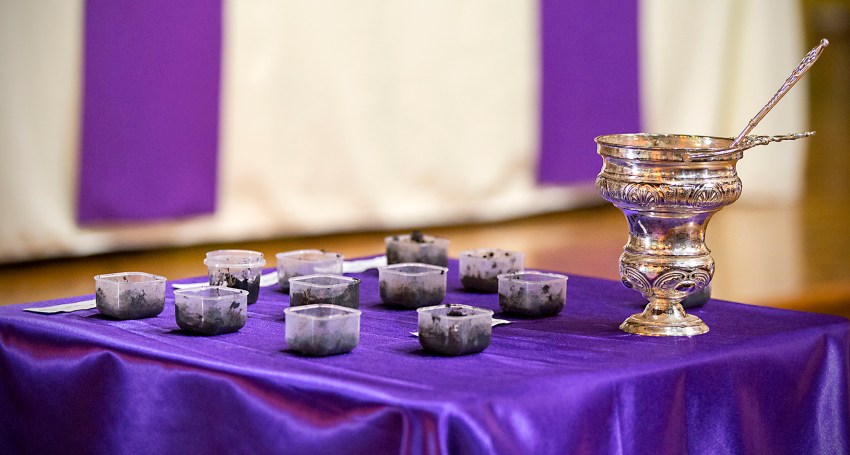
The first thing Lent does, and it does it with a kind of merciless gentleness, is hold up a mirror. The ashes pressed upon our foreheads on Ash Wednesday are not a punishment. They are a gift: the gift of truth. ‘Remember that you are dust, and to dust you shall return.’ These words do not diminish us; they locate us. They place us in our proper relationship with God and with one another.
We live in an age that is terrified of stillness and allergic to self-examination. Our screens, our noise, our relentless busyness, all of it conspires to keep us from the one thing that Lent asks of us: to look honestly at our own lives.
Where have we chosen comfort over courage? Where have we mistaken routine for relationship: with God, with our families, with the poor? Where has our faith become a habit rather than a living encounter?
The seasoned practices of Lent – fasting, prayer and almsgiving – are not ends in themselves. They are tools for seeing. Fasting empties us, and in that emptiness we discover what we have been filling ourselves with.
Prayer turns our gaze from the horizontal to the vertical, and we are often startled by what we find when we truly look upward and inward. Almsgiving breaks open the shell of self-sufficiency and reminds us that we are bound to one another, that the sister or brother in need is not an inconvenience but a sacrament.
II We are invited to grieve what we have lost
There is a grief at the heart of Lent that we do not always speak about plainly and I think we are the poorer for our silence on it. Maybe for some, surprisingly, Lent calls us to mourn, not despairingly, but honestly. Mourn the distance we have placed between ourselves and God. The liturgy, our greatest teacher, calls this sin, and it is not a fashionable word. But it is an honest one.
Sin is not merely a list of rule infractions. It is, at its core, a turning away, a choosing of something lesser in the place of the One who is our deepest longing and our truest home. And when we sit with that reality honestly, there is sorrow. There should be sorrow. The prodigal son, sitting in the pigsty, ‘Then he came to his senses’ – that is how the Gospel puts it. He came to himself. And in coming to himself, he found
the path back to his father.
The Church in her wisdom does not leave us in that sorrow. She leads us through it. The purple of Lent is not the colour of despair; it is the colour of preparation. It is the colour of dawn not yet arrived but already promised. We grieve, yes. But we grieve with hope, because we know that the Father is already running toward us while we are still a long way off.
III We are invited to receive what we cannot earn
This is, I believe, the most difficult and most liberating truth of Lent: we cannot make ourselves right with God by our own effort. Lent is not a transaction. We do not fast hard enough or pray long enough to purchase our redemption. That has already been accomplished, at incalculable cost, on a hill outside Jerusalem.
What Lent invites us to do is to receive what has already been given. To open our hands, which are so often clenched around our own plans and certainties, and to allow grace to enter. This is harder than it sounds. We are a proud species. We would rather earn than receive. But the Gospel is not the story of humanity’s achievement; it is the story of God’s gift.
The season builds, inexorably, toward the Paschal Triduum. It builds toward the cross and then toward the empty tomb. Everything in these 40 days is ordered toward that moment when death itself is undone and the love of God is shown to be stronger than anything the world can throw against it. We fast so that we might feast. We mourn so that we might be comforted. We die to ourselves so that we might rise.
Dear sisters and brothers in Christ, I invite you to receive this Lent as the gift it truly is. Sit, as the old abbot suggested, in the cell of your own heart. Let it teach you. Let it humble you. And then let it send you, lightened and renewed, toward Easter morning.
May these 40 days bring each of you, and all of us together as a Church, into a deeper, truer, more joyful encounter with the One who loved us first and loves us still. And may we know that God is good. Good indeed.
With my prayers and my blessing for a holy Lent,
“Now, now – it is the Lord who speaks – come back to me with all your heart.” – Joel 2:12