A missed opportunity
Opinion
During a recent visit to Loxton, my friend Alison was clearing out her house in readiness for sale. It was the house that I once shared with her and the young man who was to become her husband when we were in our early 20s. At the time I was working as a cadet journalist at The Loxton News.

Alison was born and raised in Lebanon, educated in the UK and Switzerland, and worked in Jordan where her father, John Tanner, was director of the United Nations Relief and Work Agency for Palestine Refugees (UNRWA).
She came to Australia to catch up with Aussie expats she met in the Middle East, including my Loxton-born husband who was working for a South Australian irrigation company in the Jordan valley.
Alison was keen to stay longer in Australia and began picking fruit in Loxton. She has lived there ever since. When we were going through her photo albums and memorabilia, we came across an article I wrote about her father for The Loxton News during one of his visits to the Riverland.
My interview focused on his role with UNRWA and his views on the Middle East which, sadly, remain just as relevant today as they were 40 years ago.
After an insightful account of the plight of the Palestinian refugees in Jordan, John concluded by saying he didn’t think there would ever be a solution to the Israel-Palestine conflict because the two groups of people both believed they had rights over the same land.
He didn’t make a judgement about whether one had a greater right than the other, although clearly he had strong sympathies for the Palestinians forced to flee their homes.
While the situation in the Holy Land is as devastating as ever, the big difference between then and now is the impact it is having on our own country.
Back in the early 80s, which was when I lived on a kibbutz in Israel and my husband was working in Jordan, there were news reports of events such as the invasion of Lebanon by the Israelis, annexing of the Golan Heights and failed peace talks between Israel and the PLO. Not a great comfort to our parents while we were away.
But with no social media to channel extremist views and a greater reliance on objective reporting by journalists, there was little of the hysteria and disunity that has become far too prevalent in Australia today.
Nor was there the extremism – in Australia at least – that has led to the tragic shooting of innocent people at a Jewish festival in Bondi, to an increasing level of antisemitic acts and to an unjustified backlash against well-minded people who want to exercise their right to protest against the obliteration of Gaza.
Immediately after the attack on December 14 there were calls for unity and beautiful gestures of goodwill such as the surfers’ heart-shaped formation in the sea at Bondi, floral tributes for the victims and their families, and interfaith vigils.
Here in Adelaide we had a moving service where political leaders from both sides of the fence and leaders of dffierent religions joined members of the Jewish and Catholic communities in lighting candles of hope.
But very soon the non-partisan response switched to a highly-charged political debate about who was to blame, whether there should be a Royal Commission and who should or should not be allowed to speak at events like Adelaide Writers’ Week.
In the case of the latter, I think this was a missed opportunity. Writers’ Week is such a beautiful example of people coming together to hear authors share their stories, to ask questions and to gain some insight into how ideas, imagination, historical and contemporary themes are transformed into stories that people want to read.
Surely all the invited authors would see the much-loved event as an opportunity to express themselves in a way that fosters unity and peace, rather than bitterness and conflict?
I find it quite frustrating and troubling that this couldn’t be pulled off in a democratic society that values freedom of expression but also dialogue and understanding.
Rather than point the finger at who is to blame for the Writers’ Week debacle (although I fear the writing has been on the wall for a while), I just wish the organisers and participants could have taken a leaf out of the book of a group called the Parents Circle – Families Forum.
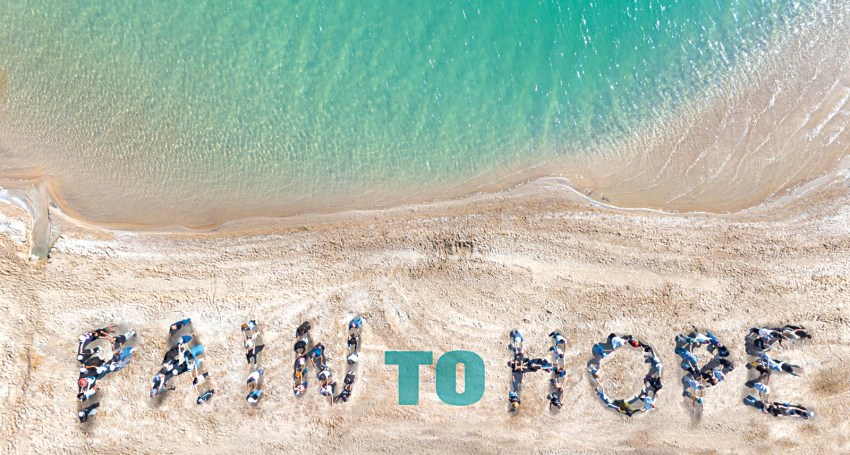
Based in the West Bank and Tel Aviv, the forum is made up of more than 850 Palestinian and Israeli families who have lost a close family member to the conflict. They regularly come together to share their pain and to promote peace, justice and reconciliation. Recently they met at the Dead Sea for a conference and formed a message of hope on the shore (image above).
If families who have experienced firsthand such loss and grief can come together in the name of reconciliation and hope, why can’t we, as Australians looking on from afar, do the same?
If only those involved in Writers’ Week could have heeded the plea of the Parents’ Circle this Christmas, published in their e-newsletter:
‘Between the attack against the Jewish community in Australia, continued hardship for Palestinians in Gaza and violence against Palestinians in the West Bank this has been a sombre holiday season so far. In moments like these, we look to our international community of peace builders for inspiration…May we continue lighting up the darkness with acts of love and solidarity. May we channel our pain into active hope.’