Rise Up: The 800 Challenge
News
St Francis of Assisi was a saint who loved God and cared for animals and the environment. He taught us to live simply, be kind to others, and respect all of God’s creation. In honour of the 800th anniversary of St Francis of Assisi’s life, the Ecology Advisory Committee and the Council for Integral Ecology and The Catholic Office for Youth and Young Adults (COYYA) set a challenge for schools across the state: choose one mission that promotes care for creation and complete it to the tune of 800.

Catholic schools rose to the challenge and a great deal of creativity went in to the entries submitted. These included 800 artworks (posters, bookmarks, flyers, and postcards) made by McAuley Community School; each one celebrating the Season of Creation and calling for action to care for the environment.
Meanwhile, at Mary MacKillop College Year 8 students built an ‘800 sculpture’ created using recycled materials
“We learnt that this year marks 800 years since St Francis wrote the Canticle of the Creatures,” said Mary MacKillop College students Adeline and Charlotte. “His message of gratitude for creation continues to inspire Catholics today and connects to Pope Francis’ Laudato Si’: On Care for Our Common Home. We reflected on how the Earth is our shared home and how caring for the environment also means caring for others.”
At Xavier College Gawler Belt, students literally turned school lights off for a total of 800 minutes across two weeks.
“Our oratory teachers planned session without lights, encouraging students also to remain off devices,” said Year 9 student Olivia.
Food and waste was the focus at St Catherine’ School, where 800 ‘nude food lunch boxes’ were created. Nude Food means bringing a lunch box containing zero wrappers and nothing that needs to go into the red rubbish bin.
“Our nude food initiative has helped reduce rubbish around our school grounds and increased awareness among families about the impact waste can have on our community,” said students Bodhi, Ella and Sophie. “It has encouraged us all to think more carefully about the choices we make and how we can help care for our world every day.”
At Cumberland Park, Cabra Dominican College ‘Green Team’ (Years 7 to 12) chose to embark on 800 laps of the school’s large oval. This encouraged students to spend their break time having conversations, getting fresh air, being technology free and clearing their minds prior to their next lesson. Students completed their laps and the challenge with a sense of achievement, knowing that their contribution made an impact.
While all entries were outstanding, three finalists stood out. Congratulations to this year’s winning schools, St Joseph’s School, Peterborough, St Patrick’s School, and Thomas More College, and to every school that participated in the challenge and brought St Francis of Assisi’s vision to life.
St Joseph’s School, Peterborough
Challenge: Delivering over 800 seeds to the community.
“We saw the competition and thought it would relate really well to the new garden program that we have implemented this year. The latest garden bed we are looking at filling is with flowers,” said teacher Jessica Robinson. “To relate with this, we decided to hand out seeds to the community of Peterborough.”
St. Joseph’s School, Peterborough, is a small school so every student was able to take part.
“This year our Diocesan theme is Growing in Hope,” said student Connor in a post-challenge reflection. “To match with our theme, we decided to deliver over 800 seeds to the people of Peterborough. We made over 100 packets of seeds, each packet had eight or more seeds, a photocopy of the seed packet and an explanation of who St Francis was.”
Each class contributed in a variety of ways, including dividing seeds into smaller packets, and delivering the seeds.
“All R-9 classes helped decorate envelopes to help spark joy when they opened it,” Connor said. “All helped pack the envelopes. The 5/6 class delivered the envelopes to all our school families.”
The exercise taught students the importance of giving to others and sharing with their community.
“By delivering seeds to friends, family and members of the Peterborough community we were able to spread joy for the gift of the seeds and in the future when the flowers grow.
It was nice when people opened up the flowers. It made people happy and will help make Peterborough a nicer looking place.”

CLEVER COLLAGE: St Joseph’s School, Peterborough, made envelopes full of seeds.
St Patrick’s School, Mansfield Park
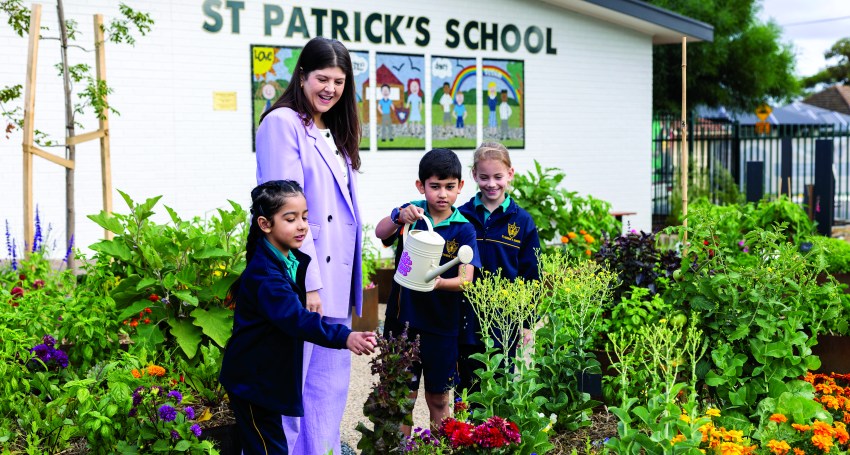
Challenge: 800 minutes of service to developing and caring for the Garden of Harmony.
Students and staff at St Patrick’s School spent 800 minutes caring for their Garden of Harmony during the Season of Creation. Students from different year levels worked together to weed garden beds, water plants, plant new seedlings, harvest vegetables and herbs, tidy pathways, and grow plants that provide food and shelter for bees, birds and other wildlife.
“Teachers, ESO staff, parents and community members also shared their knowledge and helped guide us,” said students Ramon and Giao during their reflection. “As Year 6 leaders, we enjoyed helping younger students learn new skills and develop a greater appreciation for creation.”
Through the experience, students learnt that caring for creation is everyone’s responsibility.
“Working alongside students of different ages taught us the importance of collaboration, leadership and learning from one another. Our school values of respect, responsibility and resilience helped us live the message of Laudato Si’. We showed respect by caring for nature and each other, responsibility by being good stewards of God’s creation, and resilience by continuing to care for the garden week after week, knowing that creating change takes time and commitment.”
The students said the challenge created a healthier, more welcoming garden.
Thomas More College, Salisbury
Challenge: 800 piece of recycled rubbish artwork.
Student Angelika created a collage made from recycled scrap and natural material, focusing on reuse.
“It depicts a group of sea animals,” she said during her reflection on the process. “I was stylistically inspired by Roman mosaics where small pieces assembled a larger image, and surrealist artworks where there would be dreamlike imagery.”
It was a mammoth effort.
“The experience of creating this artwork was very tiring – but interesting! I had to collect, cut, arrange, and glue hundreds of pieces,” she said.
“A technique that helped with the challenge of tracking was creating 25 sections with 32 pieces each to fit within the 800-piece limit. The limit forced me to think about what I did with my pieces. I enjoyed creating the animals, where it was satisfying seeing the main subjects come together from scrap.”
The artwork reflects the significance of pollution.
“The majority of the pieces in the artwork were plastic scraps, while natural pieces were a tiny portion. The irony was that the animals were created with plastics, a main threat to their survival. According to the WWF, over 90 per cent of coral reefs globally contain plastic debris, essentially making nature impossible to see in its purest form. I tried to make the natural pieces ‘blend in’ with the plastics, symbolising how nature and pollution become more entangled as time passes by.”
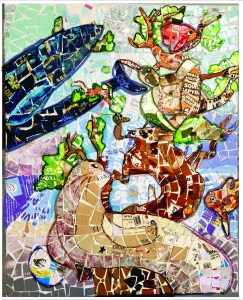
Thomas More College student Angelika’s ocean-inspired artwork.