The everyday, the extraordinary and dreaming big
News
Katherine Bennnell-Pegg had just spent the best part of 90 minutes talking about her life as Australia’s first female astronaut in front of more than 200 students at Our Lady of the Scared Heart College (OLSH) in Enfield last month, when she sat down to talk to RICHARD EVANS.
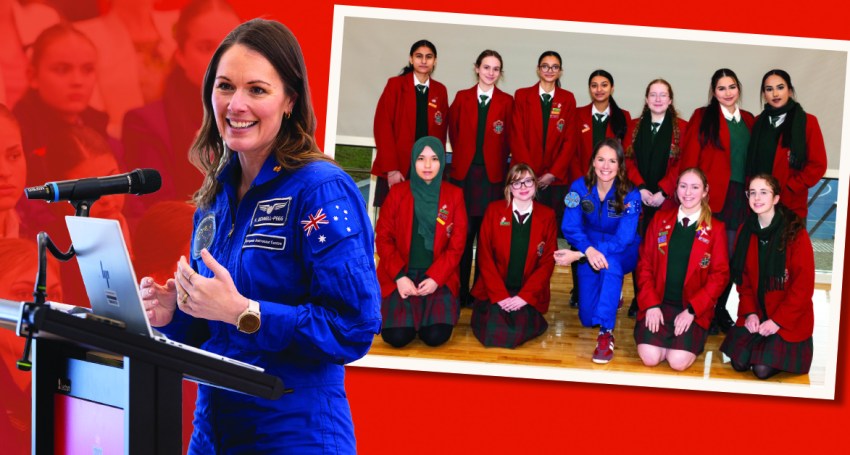
A camera, tripod and lighting were put in place as the current Australian of the Year waited patiently for filming to begin. She was wearing, as you would for a schools’ PR offensive, an official Space Agency jumpsuit adorned with badges and flags.
Her navy-blue socks dotted with cartoon rockets and astronauts were less conventional.
“Are they regulation?”
“No,” she said looking down to check out what she was wearing. “They’re my husband’s.”
It was another perfect response on an afternoon of superlatives.
The first clue to what went on to be an extraordinary afternoon at the International Coalition Girls’ Schools (ICGS), came with the noise. Put any students together for an out-of-hours trip and rustling, scrolling and whispering are the norm.
It simply didn’t happen here, the speaker bringing a focus and attention that all teachers present would have likely sacrificed a good part of their annual salaries for.
An hour in and Katherine brought her talk to a close. The moon has been done she said, Mars is the next frontier.
“The first person to walk on Mars won’t be from my generation,” she told everyone.
And then the killer line.
“But it could… be one of you.”
Even this writer, who is a good generation above Katherine, was inspired to reach for the stars and google how to retrain as an astronaut.
High reached, the girls flocked onto the floor of the OLSH College Hartzer building to have their photos taken sports team style, Katherine taking the captain’s spot each time.
As a headliner, Katherine will be nigh on impossible to match, let alone surpass. Australia’s fourth ever astronaut arrived at OLSH College by Uber and was given a lift home by a member of staff who lives
near her in Adelaide’s west. This mix of normality and the extraordinary was very much the order of the afternoon.
Katherine was there to talk under the ICGS banner of Unstoppable girls, dream big, girls who dream change the world. There was a brief fumble at the lectern at the start, “luckily IT was not part of the selection process for being an astronaut” she said, before fixing the glitch to prove that being calm under pressure very much comes with the job.
The students, in no particular order, came from across Adelaide: Kildare College, Loreto College, Mary MacKillop College, Our Lady of the Sacred Heart College, Roma Mitchell Secondary College, Seymour College, St Aloysius College, St Dominic’s Priory College, St Mary’s College,
St Peter’s Girls’ School, Mitcham Girls High School and Wilderness.
School for Katherine, a single-sex non denomination Christian offering on Sydney’s north shore, offered an excellent grounding she told
the students.
“I have had the most incredible adventures. I hope you can find your dream,” she said. “You can make the impossible possible.”
Ever since Year 8 exploring space had been a priority Katherine recalled. Like many achievers, the route to realising her goal was not straightforward. She initially applied to become a pilot only to be derailed at the last moment by a medical issue that needed lengthy analysis and which prompted her to study space engineering at university, followed by years of work within space and defence.
“You can’t just finish high school and get on a rocket,” she said. “You have to have another career first. Be a pilot, medical doctor, explore. You should have operational skills, engineering, be able to make a decision under pressure.”
Don’t be scared of STEM (science, technology, engineering, maths) subjects was a key message.
“To be an astronaut, one of the great things is you have to have another career first, so pick whatever STEM career really excites you,” she said. “That makes you want to solve problems that are important to you. And then becoming an astronaut might be the cherry on the top of that.
“One of the things I tell young people is that studying STEM, lets you be at that forefront of discovery, of having agency to make an important difference. And STEM isn’t confined to textbooks – it’s in the world around us and you don’t need to wait for permission or top marks to be curious.
“For young people, I hope they can find a dream to enjoy and to cherish whatever that may be. And that if they do that as someone that’s in the minority in that field, to know they’re going to add unique value because they might see things or bring things that others don’t. And that if they’re underestimated, to delight in proving others wrong if they do that.”
She talked about hanging in there when the going gets tough, throwing in (as an aside almost) the fact that she learned to speak Russian given it is the language of the International Space Agency.
There were videos too, moving about within the zero gravity confines that come with space travel, much expected but none-the-less revealing for it. She told everyone how to brush their teeth in space and how to keep clean – showers are a no-go with wet wipes the solution apparently. And remember to stretch in space, body mass deteriorates rapidly without a couple of hours exercise daily.
“When I come to schools, I think it’s important to show people that astronauts, space engineers, people that work in fields like space, are just normal people and one way to do that is to show what daily life is like in space.
“Same, same, but different. We still have to eat and drink, we still have to brush our teeth. We still have to sleep and everything’s different up there, in ways that are weird and wonderful and make us think outside the box and give people those anecdotes they can take away.
“But behind that are fundamental forces and physics changing the way we live up there, and that helps to hit those lessons home. Things like, when you use a drill (in space), you have to hold on or you might spin in the other direction.
“Or if you do CPR, you need to do a handstand on the patient. Those things stay in people’s minds that help them to understand what it means to be in space as well.”
That loving what do you fuels ambition and resolve came through time and again.
“When I finally got my chance to apply to being an astronaut, it took me a long time to write the motivation letter with the application. I did an all nighter, actually, to put it into words in a way that was meaningful and authentic.”
Don’t assume motivations will stay static forever Katherine said, evolution is a constant.
“When I was young, it was about curiosity and exploration and adventure. And then as I grew up, I loved science and I wanted to be part of discovery. And then, as a space engineer, I realised how important space is for uplifting people’s quality of life and also our environment.
“And now, as an astronaut, I see it’s bigger than that. It’s about unlocking new avenues for every field of science and medicine, and also to raise the aspirations of people in your nation and around the world.
“And now I’m really hoping to unlock for more Australians to be able to be involved in this incredible endeavour and that’s part of what’s driving me right now.
“I feel like the effort’s worth it, and when you’re pursuing something that is out there and unlikely, you have to feel in yourself that the effort is worth it, regardless of the outcome, and I do it in my case.”
Respect went very much two ways, Katherine enthralled and impressed by the students before her.
“I’m blown away. I am speaking to young people around the country and the eloquence, and the depth of thought and how worldly they are compared to when I was at school.
I think young people today see a lot of the challenges the world has facing it and often frame their futures, not in terms of what they want to be, but what they want to do.
“Which I think is great, because if you can frame your future as a contribution, you can find your way there with many different hats,” she said. “And, in a way, that stops you comparing yourself to others, like we might do if we target a specific profession.”