Lessons for life and not just the Synod
Synod
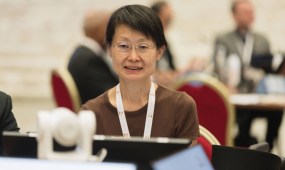
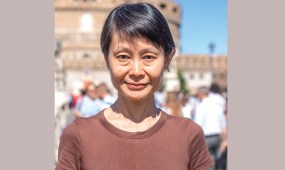
Dr Christina Kheng is a renowned lay theologian based in Singapore and was a key member of the 2021 Synod on Synodality. She was a guest of the Archdiocese of Adelaide at Dialogue Week, which ran here in late February, and was an exercise in getting as many Catholics as possible to listen to what others had to say about their view of the future of their Church.

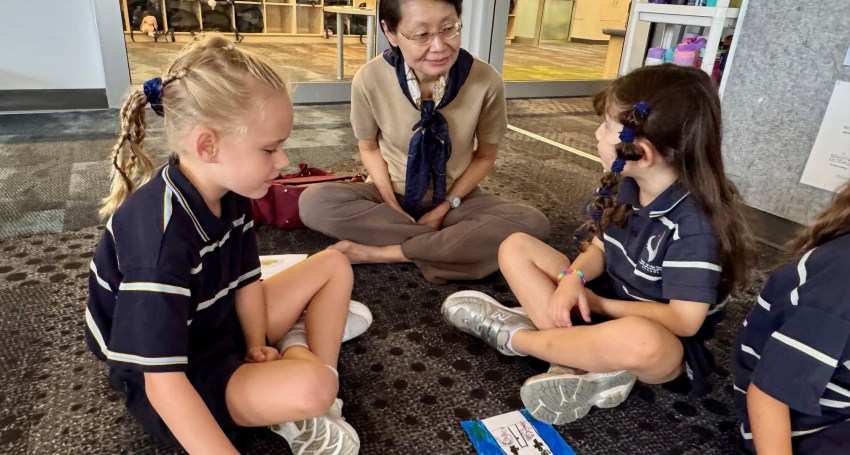
Christina met, seemingly, almost everyone. Firstly, with many members of the clergy, plus visits with two schools and with members of the public at a splendid open forum evening in Norwood. And more.
There was time, late in her visit, for a quick dash to the Sevenhill retreat centre before the week was topped off with two days in Glenelg. Friday night saw about 80 people representing the 10 advisory councils and commissions of the Archdiocese, gather to talk about communal discernment and how we might do it better.
And where, in a nod to an uber successful book ’The Seven Habits of Highly Effective People’, Christina suggested seven highly effective habits for communal discernment, one of which was to leave time for reflection and to give the attendees the chance to talk in small groups.
“People were really appreciative and inspired to listen to her. Everyone got a lot out of it and they were grateful (for her time),” said assistant director Pastoral Services at the Archdiocese of Adelaide, Peter Bierer.
Saturday was a chance to eavesdrop on the regular Diocesan and Pastoral Council (DPC) meeting where the focus was on the Synod.
“Christina worked through the process of being a member of the DPC and its connection to the Synod,” said Peter. She spent 60 minutes going around the tables and would offer suggestions. She was a ‘critical friend’ he said.
Dialogue Week and the Synod is not about any one person but having a critical friend on-hand to help show another way of doing things, and listening, was a measure of the initial success of the week.
The results of Dialogue Week will more fully reflect the thinking of Catholics in our Archdiocese but Christina’s visit offers a small snapshot of what it is about and who it touches. And why it matters.
Collecting stories of everyday Catholics
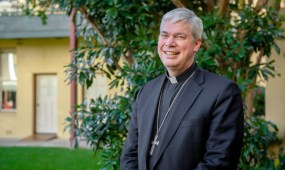
Minutes before she addressed members of the clergy, including Archbishop Patrick O’Regan, at her first formal meeting of Dialogue Week, Christina spoke to The Southern Cross.
Getting people to truly experience what it really means to encounter each other would be a fantastic outcome from Dialogue Week she said.
“Dialogue Week is not about getting data, it’s not about getting feedback, although that’s important. The Synod is not just about the assembly, the three Saturdays where the members come together, it’s the whole process involving everyone in the Archdiocese. It’s not about giving your opinion or trying to get what you want, it’s about encountering each other to sit down and have a conversation.
“How often do we make time to sit down and really listen to people’s stories, to fellow parishioners, to fellow classmates, to teachers, to one another? And to find Christ in all that sharing and that listening and that encountering? I feel this is the most important jewel of the whole process.”
Can we measure how successful a dialogue week or a Synod is, The Southern Cross enquired.
Forget any quantitative dimensions she replied.
“It’s not overnight but this whole change in the way that we relate to each other, in the way we listen to one another, is eventually palpable and I hear it from people who have experienced this thing.
“They find their diocese is slowly changing and people are starting to understand each other. They are starting to be more sensitive about who is not in the room and who needs to be included. They are more aware of one another’s situations and issues and that change will come over time. Many people say it is palpable, you do feel a change in the diocese.”
And then something of a curveball question, followed by an emphatic and simple answer.
Does it matter what the non-Catholic world, thinks about the Synod?
“It’s really a turnaround in the sense that the starting point is the mission of the church, to be a sign of love and communion and hope. The world needs hope so desperately today, because of all the things that have been happening, and to me that’s a sign of hope,” she said.
“If people can learn to collaborate together, to work together, regardless of where we are from, regardless of our our differences and to find that path forward together, that really is the call for the whole of of humanity.
And that’s why the Synodality within the church, is very important. We need to examine how we are a community with one another. It’s never perfect but if we can at least show that we are keen, we want to learn, to be that way with each other. Then we give the world some hope that we are trying. To me, that’s the prophetic witness that the community of Christ is called to give to the world.”
The Synod for the Archdiocese of Adelaide has five papers with five separate, but interlinking, themes. Do you have a favourite she was asked?
“I have a favourite under the theme of mission and that recommendation is to collect stories of how ordinary Catholics are living their mission in their daily lives. I think that’s really key.
“Synodality is not about doing more activities in the church but it’s to realise how we in our daily lives can, can be Christ to other people, to one another and to collect narratives and stories like that.
“It’s just so powerful. It really awakens how God is already working and living among the people and how that can be encouraged to grow.”
The art of avoiding silos and squilibrio
As beginnings go, it was a question borne of experience and empathy.
“How many of you know more than 50 per cent of the people in this room?” Christina Kheng asked her audience.
They looked around, we all looked around, ‘none’ pretty much the collective answer from the Dialogue Week public gathering at the Altavilla Club in Norwood.
Already the query was working, some people turning 180 degrees in their seats to check out who had turned up, who was a pal, who they might have seen before, who was new. A few seconds into the evening only and, silently and subconsciously, people were engaging. It was the first minute only of a two hour masterclass.
“We are not a secular organisation, we are the community of Christ,” said Christina before throwing questions thick and fast at all attendees.
“How do you cross from vision to action,” she enquired. “There are some paradigms that inhibit crossing the threshold.”
Sometimes we fear the change we desire she said, we can be too attached to our comfort zone. Some parishes won’t venture beyond what they know and so the gap in their perception becomes a monster, bigger than it is.
We need to question these paradigms said Christina before offloading some more of her own.
“How is Christ being mission through others to me,” she asked? “How is God moving the church? What is my here and now?”
Synodality happens when people take responsibility she said before invoking Pope Francis who famously endorsed the mantra that ‘realities are more important than ideas’.
Having specific aims is a must she said, too many big and bold ideas and it won’t happen.
“Don’t have too many goals or you can’t manage them. Move on from ‘we’re already doing that’. That stops any action whatsoever.
“Have feasible steps that can be started immediately, have a clear road map and grow at a suitable pace.”
“The important thing is to try out new ideas,” she said. “This can include reaching out to marginalised groups for different ways of making decisions in parishes or committees. Be intentional about the new ways of working together.”
Synodality is a matter of listening to the holy spirit and not an information exercise Christina said.
“How do we change the mentality and create discernment which is listening to the holy spirit?”
A Synod is a bit like moving house she said, everyone has to carry their fair share of the weight.
“We all have a responsibility to carry the church and to make this conversion from ‘I to we’.”
Schedule regular collective evaluations this Synod, it’s not a performance review Christina said and celebrate progress whether big or small. Encourage others and take it to the next step.
Avoid working in silos, co-ordinate efforts across diocese she said. Once a synod is over, it doesn’t mean you can’t keep in touch. And the Synod is for everyone.
And then just as we thought we’d heard it all and arty presciently given the Italian venue Christina came up with the concept of squilibrio (moments of imbalance).
“We can’t do anything good if we are afraid of the squilibrio,” she said. “We have to take it into our hands.
“We are building the place even as we are flying it. Only when you fly it will you know how to build it.”
After the deluge of ideas came a time for reflections in small groups and perhaps the last word should go to youth leader Tahlia Sully, the youngest person in the room.
“It’s no accident that we were called into a year of hope last year and now we have this year” she said.
She is, she emphasised, seeing “so much hope in this process of dialogue. Even if (young people) don’t know what a Synod, is, they can see the love through talking.”
It was a fitting end to an unconventional but stimulating evening.
Young people are the present as well as the future
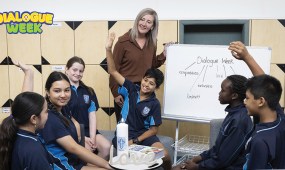
The highlight, perhaps, of Christina’s visit, was a trip to see how South Australia’s schools were engaging in Dialogue Week and the Synod. St Mary’s and the Star of the Sea were the hosts.
We have 57,000 children in Catholic schools in SA plus 10,000 staff The Southern Cross told her. How do they matter?
“Their voice is important as the presence of the Catholic Church. They are the future but they are also the present and in the global synod process, that’s what the youth have been reminding us. They they keep telling us, ‘Hey, you know, we’re not just the future of the church, but we are the present. We are the church today’.
“And so it’s key to listen to their experiences, to get their fresh perspectives about how to be church. One thing I really like to highlight is that Synodality is not about doing more things in the church. It’s not about having more activities and programs, it’s really about examining the way we are being church.
“How are we being church for the world, for one another, internally? How can we improve on the way we are church? How do we better reflect more clearly the face of Christ?”
It’s rare to have a whole week dedicated to the Synod Christina said and to” get all the Catholic schools, all the students, everyone in it, to undergo a listening and a conversation process”.
“And that is a wonderful achievement. It’s something I hope people would take to heart and would cultivate over time, so that even when Dialogue Week is over, when the Synod assembly is over, this way of talking to one another, this way of sitting in conversation, to listen, to reflect on important issues together,” she said.
“I hope this will be a permanent way of proceeding among people.”
‘What young people are describing is exactly the kind of church we want to be’
Shortly after a late dash with the Archdiocese’s assistant director (Pastoral life and mission) Peter Bierer, to check out the Sevenhill retreat centre (dating back to 1851) Christina reflected on an enormous seven days in South Australia.
It had, said Christina, been a very grace filled week.
“I’ve been blessed to meet so many people from all corners of the diocese. The first thing that strikes me is the energy, goodwill and enthusiasm with which people are picking up on the Synod process,” she said.
“I’ve come across different groups and parishes, getting together, organising the Dialogue Week consultations. And what strikes me is the level of commitment and earnestness and sincerity with which people want to come forward and to dream together of being a better Church. A Church which better reflects the face of Christ in our time.
“It’s been very impressive to see people of all ages, giving their ideas, reflecting on the current realities in the Church and also to work across commissions and councils to really engage more deeply in reflecting on how you are being Church. To see where God is calling you to move forward in terms, especially of mission, communion and participation.”
She was particularly struck by participating in the schools sessions at St Mary’s and The Star of the Sea.
“Often we think young people are not really interested in religion or they’re not really interested in the church. But (from) what I’ve heard, it’s not that they don’t want more religion or that young people want less religion.
“In fact, they want more religion but just what kind of religion? They know clearly the kind of religion that has a meaning for them. And I feel what they are describing is exactly the kind of church we want to be.
“They want more communion, they want more bonding, more meaningful relationships. They want to engage whenever we get together for liturgies, for the Eucharist. They see that there’s a need for conversation for communion. They’re even talking about sharing with each other how we find God in our daily life this past week.
“And I was thinking, how wonderful if our regular gatherings as a church can be like that. And that really builds us up as the community of disciples as the people of God.”
The commitment and love from ‘the people behind the scenes’ during Dialogue Week were not missed by the visitor.
“A lot of people don’t really see all the work that goes into this, whether it’s done by the diocesan officers or the teachers who are organising the sessions in the schools.
“I’m very touched and deeply impressed by the commitment, the sincerity and the creativity and energy and enthusiasm and generosity that so many people have in bringing all this together.
“People are liking this way of being Church, of listening, sharing, dialoguing and trying to listen the way forward together. A few people have said that they want this to be a way of proceeding even when they are talking about other issues. They want to apply these methods of listening and sharing on other topics and other challenges as well.
“And because of that, the outcomes and dreams that have been associated with the Synod are already being achieved simply in this process of engaging with one another in a prayerful way, listening and discerning the way forward together.”
There were a final few words of advice.
“Going forward towards the Synod, it’s important to have your eyes on two things.”
First came context.
“If you want to be a better phase of Christ in these times, then you have to understand these times,” she said.
“What are these times? Who are the people who are in need of the good news? Who are the people who you will be editing? What are the current challenges, the current trends in society? So you have to be really attentive to the world around you and the call of God is out there.
“The second thing is, you really need to be looking at each other and looking out for each other.”
Listen and share and be a community together she said.